A Two-Week Emergency Preparedness Plan: Supply List and Checklist
Sheltering at home for 14 days takes 1 gallon of water per person per day, food that needs little or no cooking, a safe way to cook and stay warm or cool without carbon monoxide risk, a toilet plan for when the plumbing can't be used, and enough medication to bridge the gap.
By Aditya BawankuleUpdated
Disclosure: This page contains affiliate links. We may earn a commission on purchases at no cost to you. Read the disclosure
What does a two-week household plan cover?
A two-week plan lets your household stay home for 14 days without power, running water, or stores. It covers water, food, cooking, sanitation, temperature, medications, and pets, sized to the number of people in your home. The 14-day target comes from the CDC, which recommends storing at least 3 days of water and a 2-week supply if possible.
Most of the plan is power outage preparedness, because an extended outage is the most common reason to shelter at home: Ready.gov notes outages can disrupt water, communications, and transportation and close grocery stores, gas stations, ATMs, and banks. If you are starting from scratch, work through how to start prepping first; this plan extends those basics to two weeks.
How much water does your household need for two weeks?
Plan on 1 gallon per person per day: 14 gallons per person for 14 days. The CDC and Ready.gov both use that baseline for drinking, cooking, and hygiene. The table scales it by household size, with the number of 5-gallon containers that holds it and the number of meals to plan for the same period.
| People | Water, 3 days (gal) | Water, 14 days (gal) | 5-gal containers | Meals, 14 days |
|---|---|---|---|---|
| 1 | 3 | 14 | 3 | 42 |
| 2 | 6 | 28 | 6 | 84 |
| 3 | 9 | 42 | 9 | 126 |
| 4 | 12 | 56 | 12 | 168 |
| 5 | 15 | 70 | 14 | 210 |
| 6 | 18 | 84 | 17 | 252 |
Treat these as minimums. The CDC advises storing more for pregnant women, people who are sick, pets, and hot climates, and Ready.gov notes water needs can double in very hot temperatures. It also says never to ration drinking water unless officials tell you to: drink what you need today and look for more tomorrow.
Store-bought bottled water, sealed and kept somewhere cool and dark, is the simplest supply. Water you bottle yourself belongs in food-grade containers and should be replaced every six months, per Ready.gov. If a storm is coming, a bathtub bladder holds up to 100 gallons of tap water filled before service is disrupted. Container options are compared in water storage containers for apartments and houses.
Short-notice water storage
Purchases through these links support the site at no extra cost to you. (?)
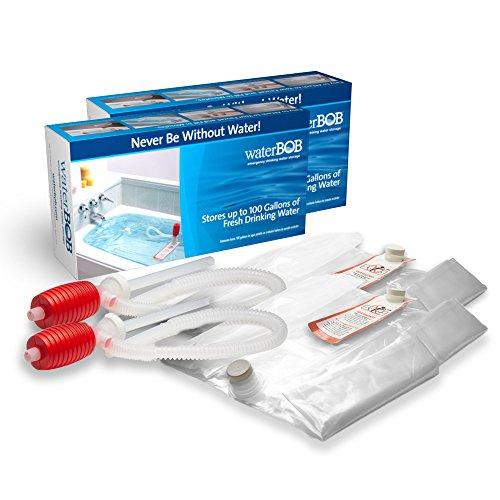
WaterBOB
WaterBOB Bathtub Emergency Water Storage
Liner that holds up to 100 gallons of tap water in a standard bathtub, with a pump to dispense into jugs. WaterBOB says it keeps water fresh for up to 16 weeks.
- Holds up to 100 gallons
- Includes a dispensing pump
- Fills in about 20 to 30 minutes
$39.00
Out of stock· checked
Temporarily out of stock. Expected availability early December.
What food do you need for two weeks at home?
Plan 3 meals per person per day from food that needs no refrigeration and little or no cooking or water, and include a manual can opener. Ready.gov recommends canned meats, fruits, and vegetables, protein or fruit bars, dry cereal or granola, peanut butter, dried fruit, canned juice, shelf-stable milk, comfort foods, and anything infants or family members with special diets need.
Eat what will spoil first. Ready.gov says a closed refrigerator keeps food cold for about four hours and a full freezer holds its temperature for about 48 hours. Keep the doors shut, check temperatures with a thermometer, and throw out perishables such as meat, poultry, fish, eggs, and leftovers that have been above 40 degrees Fahrenheit for two hours or more. Then move to the pantry.
Whether to fill the pantry from the grocery store or with long-shelf-life emergency food is covered in emergency food buckets vs. a grocery-store reserve, and the options are priced per 1,000 calories in emergency food compared.
How do you cook safely without power?
Cook outdoors, or skip cooking. Charcoal grills, camp stoves, and generators produce carbon monoxide (CO), an odorless, colorless gas, so the CDC and Ready.gov say to use them outdoors only. Commercially canned food can be eaten straight from the can, and Ready.gov lists candle warmers, chafing dishes, fondue pots, and a fireplace as indoor alternatives.
To heat food in its can, Ready.gov says to remove the label, wash and disinfect the can, and open it before heating. Plan meals that need little or no cooking so a cold, wet day doesn't push anyone toward using a grill or stove inside.
Plug-in CO alarms without a battery backup stop working when the power does, which is exactly when the risk rises. The CDC suggests a detector with a digital readout, which shows the highest CO level it has measured. A battery power station is the fuel-free alternative to a generator: it produces no exhaust, so it can keep phones, lights, a radio, or a medical device running from inside the house, and it recharges from a wall outlet or solar panels.
CO safety and fuel-free power
Purchases through these links support the site at no extra cost to you. (?)
First Alert
First Alert CO710 Carbon Monoxide Alarm with 10-Year Battery and Digital Display
Battery-powered carbon monoxide alarm with a sealed 10-year lithium battery and a backlit display that shows CO concentration and room temperature.
- Sealed 10-year lithium battery, no battery changes
- Backlit display shows CO level and recent peak
- Electrochemical sensor, listed to UL 2034
Anker SOLIX
Anker SOLIX C1000X Portable Power Station (1,056Wh, 1,800W)
A 1,056Wh lithium iron phosphate (LiFePO4) battery station with six AC outlets and 1,800W continuous output. It burns no fuel, so it can run indoors.
- 1,056Wh LiFePO4 battery, rated 3,000 cycles to 80%
- 1,800W pure sine wave AC output, six AC outlets
- Recharges from a wall outlet or up to 600W of solar
What do you do for a toilet if the plumbing stops working?
It depends on what failed. If the sewer works but the water is off, you can flush by pouring water into the bowl, and the CDC notes that water unsafe to drink can still be used for flushing. If the sewer may be damaged, don't flush until local officials say it is safe, and use a bucket toilet instead.
FEMA's supply checklist includes a medium-sized plastic bucket with a tight lid, heavy-duty garbage bags and ties, and household chlorine bleach for sanitation. Oregon State University Extension, drawing on Portland-area emergency planners, describes a twin-bucket toilet that keeps urine and feces separate, which cuts odor and volume:
- Label two 5-gallon buckets with lids "pee" and "poo." Line the poo bucket with a heavy-duty black bag, 3 to 5 mil thick (often sold as contractor bags).
- After each use of the poo bucket, cover the waste with about a half cup of dry material: sawdust, wood shavings, shredded paper, bark chips, or peat moss.
- Fill the poo bucket no more than half full. Wearing disposable gloves, double-bag the waste, seal it, and store it apart from other garbage and far from food and water, secured from pets and pests.
- Follow local officials' disposal instructions. OSU Extension advises not putting human waste in regular household garbage.
Set up a handwashing station next to the toilet: a jug of clean water with a spigot, soap, and a catch basin. When soap and water aren't available, the CDC recommends hand sanitizer with at least 60% alcohol. For two weeks, stock several boxes of heavy-duty bags, toilet paper, gloves, cover material, and soap.
Emergency toilet
Purchases through these links support the site at no extra cost to you. (?)
Camco
Camco Portable Toilet Bucket with Snap-On Seat and Lid, 5 Gallon (41549)
A 5-gallon toilet bucket with a snap-on seat and lid, a carry handle, and three bag liners: the core of a bucket toilet when the plumbing can't be used.
- 5-gallon bucket with snap-on seat and lid
- Includes 3 disposable bag liners
- Smooth interior and built-in carry handle
$32.99
Backordered· checked
Usually ships within 1 to 4 weeks
How do you stay warm or cool without power?
Dress for the temperature, use only safe heat sources, and go somewhere with power if your home becomes dangerously hot or cold. Ready.gov's power outage guidance is to go to a community location with power when heat or cold is extreme, and to check with local officials about heating and cooling centers.
In cold weather, wear layers and watch for hypothermia: Ready.gov lists shivering, exhaustion, confusion, fumbling hands, memory loss, slurred speech, and drowsiness as signs, and treats a body temperature below 95 degrees as an emergency. If you use a wood stove, fireplace, or space heater, the CDC says to be extremely careful and follow the manufacturer's instructions. Never use a gas oven or stovetop for heat.
In hot weather, Ready.gov advises against relying on a fan as your main cooling device, since fans don't lower body temperature. Take cool showers, wear loose, light-colored clothing, drink plenty of fluids, cover windows with drapes or shades, and check on older neighbors and family members.
How do you plan medications for two weeks?
Talk to your doctor or pharmacist now about an emergency supply, and keep at least a week of daily medication on hand, which is Ready.gov's baseline for people who depend on it. If a week isn't possible, keep as much as you can and ask your pharmacist what else to do. Some states let pharmacists refill prescriptions early during a declared emergency; the rules vary by state.
Keep a written list of each medication with dosage, frequency, and allergies, plus extra non-prescription basics. For medicines that need refrigeration, keep a cooler and chemical ice packs ready. Ready.gov advises discarding refrigerated medication if the power has been out for more than a day, unless the label says otherwise, and calling your doctor or pharmacist for a new supply. If anyone uses a powered medical device, ask the provider about a power outage plan.
What do pets need in a two-week plan?
Pets need their own food, water, medicine, and sanitation supplies. Ready.gov recommends food in an airtight, waterproof container, water and a bowl, an extra supply of any medicine your pet takes, a pet first aid kit your veterinarian recommends, a collar with ID tag and a leash, a carrier, and litter or bags, paper towels, and bleach for cleanup.
Count pets when you size your water, since the CDC advises storing extra for them. If you might have to leave, plan a pet-friendly destination; Ready.gov notes most public shelters allow only service animals.
Two-week checklist by category
Use this as the shopping list before an outage and the routine during one. The printable shelter-in-place checklist covers the same ground on one page.
| Category | Stock now | During the outage |
|---|---|---|
| Water | 1 gal per person per day for 14 days; extra for pets and hot weather | Drink what you need; don't ration unless officials say to. Use known-safe water first |
| Food | 3 no-cook or low-cook meals per person per day, a manual can opener, utensils | Keep the fridge and freezer closed; eat perishables first; check temperatures |
| Cooking and CO safety | Battery-powered CO alarms; an outdoor-only stove or grill with fuel | Grills, camp stoves, and generators outdoors only. Never heat with a gas oven |
| Sanitation | Two lidded 5-gallon buckets, 3 to 5 mil bags, cover material, gloves, toilet paper, soap | Don't flush until you know the sewer works; bag and store waste away from food and water |
| Light and power | A flashlight per person, spare batteries, power banks, a battery or crank radio | Use flashlights, not candles; unplug electronics against power surges |
| Temperature | Blankets and warm layers; a list of local warming and cooling centers | Go to a community location with power if heat or cold becomes extreme |
| Medications | At least a week of daily medicine, a written list, a cooler with ice packs | Keep refrigerated medicine cold; if power is out over a day, discard it unless the label says otherwise and call a pharmacist |
| Pets | Food and water for the same 14 days, medicine, litter or bags, a carrier, ID | Keep pets indoors and away from generators and grills |
Where to go from here
Once the two-week basics are covered, build out the gaps: a 72-hour emergency kit you can grab, a go bag for evacuations, a car emergency kit, and a plan for phone, internet, and card payment outages. To spread purchases out, see your first $100, $300, and $1,000 in preparedness purchases.
Get outage alerts and checklists by email
What changed, what it means for your household, and the one action worth taking.