Water Storage Containers for Apartments and Houses
Store at least one gallon of water per person per day, and aim for two weeks. In an apartment, that means stackable bricks, 5-gallon jugs, and bottled water spread across closets; in a house with a garage or basement, a 55-gallon drum with a pump is the most water for the space. Clean containers with a bleach rinse, replace self-filled water every six months, and keep a way to treat more.
By Aditya BawankuleUpdated
Disclosure: This page contains affiliate links. We may earn a commission on purchases at no cost to you. Read the disclosure
How much water to store for an emergency
Store at least one gallon of water per person per day. That is the guidance from both Ready.gov (FEMA) and the CDC, and it covers drinking plus basic sanitation such as brushing teeth and washing hands. The CDC says to store at least 3 days and to aim for a 2-week supply if you can.
One gallon is a floor, not a target. Ready.gov notes that a normally active person needs about three quarters of a gallon of fluid a day, and that children, nursing mothers, and sick people may need more. In very hot weather, water needs can double. The CDC also suggests storing extra for pregnant women and pets. The table below uses the one-gallon minimum, so adjust up for your household.
| People | 3 days (gal) | 7 days (gal) | 14 days (gal) | 14-day weight (lb) |
|---|---|---|---|---|
| 1 person | 3 | 7 | 14 | 117 |
| 2 people | 6 | 14 | 28 | 233 |
| 3 people | 9 | 21 | 42 | 350 |
| 4 people | 12 | 28 | 56 | 466 |
| 5 people | 15 | 35 | 70 | 583 |
| 6 people | 18 | 42 | 84 | 700 |
The weight column matters as much as the gallons. Water weighs about 8.33 pounds per gallon (USGS), so a two-week supply for a family of four is 56 gallons and roughly 466 pounds. That is why the container choice depends on where you live.
Water storage containers compared
The best water storage container is the one that fits your space and that you can actually move, clean, and refill. Small stackable containers suit apartments and anyone who needs to carry water. Large drums suit houses with a ground-level spot where 450-plus pounds can sit permanently. Bathtub bladders and collapsible carriers add capacity when you have warning. Sealed bottled water is the zero-effort baseline.
| Container | Gallons each | Water weight (lb) | Best for | Watch out for |
|---|---|---|---|---|
| Stackable bricks | 3.5 | 29 | Apartments: under beds, closet shelves, stacked walls | Most containers per gallon to fill and rotate |
| 5-gallon jugs and stackers | 5 | 42 | Any home; easiest size to carry when full | Spigots often sold separately |
| 7-gallon jugs | 7 | 58 | Fill-in-place storage with a built-in spigot | Too heavy for many people to carry full |
| 55-gallon drums | 55 | 458 | Houses with a garage, basement, or slab floor | Immovable when full; needs a pump or siphon |
| Bathtub bladders | 100 | 833 | Storms and outages you see coming | Single use; useless without warning |
| Collapsible carriers | 5 | 42 | Backup capacity, car kits, water distribution points | Empty until you fill them |
Weights above are the water alone at 8.33 pounds per gallon. Add a few pounds for a rigid container.
Stackable water bricks and 5-gallon stackers
Stackable containers are the best fit for apartments because they turn dead space into storage. Water bricks, the flat 3.5-gallon containers that interlock like building blocks, measure 9 by 18 by 6 inches each, which is shallow enough to slide under most beds or line a closet shelf. WaterBrick recommends stacking filled bricks no higher than 4 feet.
Stackable 5-gallon containers with flat tops and bottoms do the same job at a lower cost per gallon. Each weighs a little over 40 pounds full, which is about as much as most adults want to carry. Plan on buying spigots separately if the set does not include them; pouring from a full 5-gallon container is awkward.
Stackable containers
Purchases through these links support the site at no extra cost to you. (?)
WaterBrick
WaterBrick Standard 3.5-Gallon Container (2-Pack)
Stackable 3.5-gallon HDPE water bricks that interlock like building blocks. Sold in pairs; each brick is 9 x 18 x 6 inches.
- 3.5 gallons per brick, two bricks per pack
- Interlocking, cross-stackable design
- 9 x 18 x 6 inch footprint per brick
$54.50
Backordered· checked
Available on backorder
Saratoga Farms
Saratoga Farms 5-Gallon Stackable Water Storage Containers (4-Pack, 20 Gallons)
Four 5-gallon HDPE containers with flat tops and bottoms that nest together for stacking. 20 gallons total, lids included.
- Four 5-gallon containers, 20 gallons total
- Flat tops and bottoms for stacking
- BPA-free, food-grade HDPE
$119.98
In stock· checked
Usually ships within 2 to 3 days
5- to 7-gallon jugs like the Reliance Aqua-Tainer
Single jugs in the 5- to 7-gallon range are the flexible middle option: big enough to matter, small enough to fit in a closet corner or a car. The Reliance Aqua-Tainer holds 7 gallons in a square 11.5 by 11.25 by 15.75 inch body with a hideaway spigot, so you can dispense without lifting it. At about 60 pounds full, treat it as a container you fill in place.
Narrow military-style 5-gallon cans, such as Scepter's, are easier to carry and stand side by side in tight spaces, which makes them a good choice if the same water might need to go with you during an evacuation. Reliance warns that prolonged sunlight makes its containers brittle, so keep any plastic jug in a shaded spot.
Water jugs
Purchases through these links support the site at no extra cost to you. (?)
Reliance
Reliance Aqua-Tainer 7-Gallon Rigid Water Container
Rigid 7-gallon jug with a hideaway spigot and screw-on vent. Square footprint, stackable when empty, BPA-free polyethylene.
- 7 gallons (26 liters)
- Reversible hideaway spigot
- 11.5 x 11.25 x 15.75 inches
$23.99
Out of stock· checked
Scepter
Scepter Military Style Water Container, 5 Gallon
Narrow, military-pattern 5-gallon (20-liter) water can in BPA-free HDPE. Its 6.8-inch width fits between shelves and in vehicle cargo areas.
- 5 gallons / 20 liters
- BPA-free HDPE
- 13.7 x 6.8 x 18.8 inches
$58.37
In stock· checked
55-gallon drums, pumps, and siphons
A 55-gallon drum stores the most water in the least floor space, and it is the right choice for a house with a garage, basement, or ground-floor utility room. One drum covers a family of four for nearly two weeks at one gallon per person per day.
The trade-off is weight. A full drum holds about 458 pounds of water, so it stays wherever you fill it. You need a drum pump or siphon to get water out: a hand pump that threads into the drum's 2-inch bung opening lets you fill pitchers and jugs without electricity, and many can start a siphon so gravity does the rest. Use a pump that is dedicated to drinking water and has never touched fuel or chemicals, and confirm that its bung adapter matches your drum's openings.
Rotation is the other cost. Replacing stored water every six months means draining and refilling 55 gallons, so put the drum somewhere a garden hose can reach.
Drum and pump
Purchases through these links support the site at no extra cost to you. (?)
Augason Farms
Augason Farms 55-Gallon Water Storage Barrel
Closed-top 55-gallon water drum in BPA-free, food-grade polyethylene with two plug fittings for filling and drawing water.
- 55 gallons
- Two plug fittings for fill and drain
- 22.95 inches wide, 35.13 inches tall
$169.99
In stock· checked
Usually ships within 4 to 5 days
TERA PUMP
TERA PUMP Emergency 55 Gallon Drum Water Pump
Manual lever-action drum pump with a 2-inch bung adapter. Moves up to 5.5 gallons per minute; listed as BPA-free and safe for drinking water.
- Up to 5.5 gallons per minute
- 2-inch NPS bung adapter
- No electricity needed
Bathtub bladders and collapsible containers
Bathtub bladders and collapsible carriers add capacity when you know trouble is coming, such as a hurricane forecast, an ice storm, or a boil-water advisory. They take almost no space in storage, but they hold nothing until you fill them, so they supplement your stored water rather than replace it.
The WaterBOB is a liner that sits in a standard bathtub and holds up to 100 gallons. Its manufacturer says it fills from the tub faucet in about 20 to 30 minutes, keeps water fresh for up to 16 weeks depending on temperature and humidity, includes a pump for dispensing, and is designed for one-time use. It advises covering the bladder to keep sunlight off it and treating the water right away if you fill it from a well.
Collapsible 5-gallon carriers such as the Reliance Fold-A-Carrier fold flat in a drawer or trunk and have a built-in spigot. They are also useful for carrying water home from a distribution point.
Fill-when-warned storage
Purchases through these links support the site at no extra cost to you. (?)
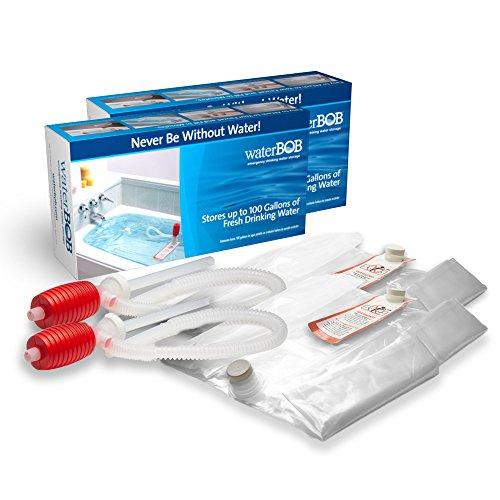
WaterBOB
WaterBOB Bathtub Emergency Water Storage
Liner that holds up to 100 gallons of tap water in a standard bathtub, with a pump to dispense into jugs. WaterBOB says it keeps water fresh for up to 16 weeks.
- Holds up to 100 gallons
- Includes a dispensing pump
- Fills in about 20 to 30 minutes
$39.00
Out of stock· checked
Temporarily out of stock. Expected availability early December.
Reliance
Reliance Fold-A-Carrier 5-Gallon Collapsible Water Container
Collapsible, transparent 5-gallon (20-liter) water carrier with an on-off spigot. Folds flat for storage and weighs about half a pound empty.
- 5 gallons / 20 liters
- Folds flat when empty
- Leak-proof on-off spigot
$22.72
In stock· checked
Free shipping; sold and shipped by Sportco Warehouse Sporting Goods
Store-bought bottled water
Unopened, commercially bottled water is the safest and most reliable emergency water source, according to the CDC. It needs no cleaning, filling, or treatment. Ready.gov says to keep it in its sealed original container in a cool, dark place, and the CDC says to follow the expiration date on the package.
Bottled water works especially well in apartments because cases stack in closets and spread the weight around the home. Many households keep a base of bottled water and add refillable containers on top of it.
Apartment vs. house: weight, floors, and where to store water
In an apartment, spread water across several rooms in small containers; in a house, put the bulk of it in a drum or stacked jugs on a ground-level floor. The deciding factor is weight: water is about 8.33 pounds per gallon, and it adds up fast.
The International Residential Code, which most US houses are built to, sets minimum design live loads of 40 pounds per square foot for living areas and 30 for sleeping areas. A full 55-gallon drum puts roughly 476 pounds on a circle about 23 inches across, or about 166 pounds per square foot on its own footprint. Floors spread a concentrated load across joists, so that comparison does not mean a floor will fail. It is the reason drums belong on a concrete slab, a basement floor, or a ground-floor garage, and why anyone on an upper floor should ask the building manager before bringing one in.
| Home | Containers that fit | Where to put them |
|---|---|---|
| Apartment | Bottled water, stackable bricks, 5-gallon jugs, bathtub bladder, collapsible carriers | Under beds, closet floors and shelves, behind the couch; spread across rooms |
| House | 55-gallon drum with pump, stacked 5-gallon containers, plus bottled water | Basement or ground-floor utility room; a garage only if it stays cool and the water is kept away from fuel and chemicals |
Wherever it goes, the CDC's storage rules apply: keep containers in a cool place (50 to 70 degrees Fahrenheit), out of direct sunlight, and away from toxic substances such as gasoline and pesticides. A garage that bakes in summer or shares a shelf with a gas can fails on two counts.
Food-grade and BPA-free: what to look for
Use containers sold for drinking water. The CDC says it is best to use FDA-approved food-grade water storage containers, and to contact the manufacturer if you are not sure whether a container is food-grade. Never use a container that previously held toxic chemicals such as bleach or pesticides.
Manufacturers describe their materials in their own terms, and those claims are theirs, not an independent certification. WaterBrick states its container, lid, and gasket are BPA-free and FDA-compliant materials. Reliance describes the Aqua-Tainer as LFGB certified and FDA compliant, and its containers as PFAS and BPA-free. The Saratoga Farms and Augason Farms listings describe their containers as food-grade, BPA-free polyethylene.
If you have no food-grade option, the CDC says to choose a container with a top that closes tightly, made of a durable, unbreakable material (not glass), and with a narrow neck or opening if possible so you can pour from it.
How to clean and fill water storage containers
Wash with soap, sanitize with a weak bleach solution, air-dry, then fill with clean water and seal. These are the CDC's steps, using unscented liquid household chlorine bleach that contains 5% to 9% sodium hypochlorite (the label lists the percentage).
- Wash. Wash the container with soap and rinse it completely with water.
- Sanitize. Mix 1 teaspoon of unscented bleach into 1 quart (4 cups) of water and pour it into the container.
- Cover and shake. Close the container tightly and shake it so the solution touches every inside surface.
- Wait. Let it sit at least 30 seconds, then pour the solution out.
- Dry. Let the empty container air-dry before use.
- Fill. Pour in clean water and cover it with a tight lid.
- Label. Mark it "drinking water" with the date you filled it.
Fill from a safe, treated tap supply. If your water comes from a source you are unsure of, make it safe first: boil it and let it cool, or disinfect it with bleach using the amounts below, then store it in the sanitized container.
| Water | Dropper | Milliliters | Measuring spoon |
|---|---|---|---|
| 1 quart or liter | 2 drops | 0.1 mL | A tiny amount |
| 1 gallon | 8 drops | 0.5 mL | Slightly less than 1/8 teaspoon |
| 5 gallons | 40 drops | 2.5 mL | 1/2 teaspoon |
How often to replace stored water
Replace water you filled yourself every six months, per both the CDC and Ready.gov. Store-bought bottled water lasts until the expiration date on the package. A bathtub bladder is a short-term container: the WaterBOB manufacturer says up to 16 weeks.
Pick two dates six months apart and put them on your calendar. When you rotate, use the old water for cleaning, flushing, or plants, wash and sanitize the container, and refill it. Rotation is easier when containers are small or within reach of a hose, which is one more reason to match container size to your space.
| Water | Replace |
|---|---|
| Self-filled containers (bricks, jugs, drums) | Every 6 months |
| Sealed store-bought bottled water | By the expiration date |
| WaterBOB bathtub bladder | Up to 16 weeks, then discard the liner |
Using stored water and finding more at home
Pour or pump water out rather than reaching in. The CDC says to use a clean scoop each time if you need one, and not to touch the water or the inside of the container with your hands.
If your stored water runs low, the CDC lists other sources inside the home: water from the tap water heater tank (not a radiator or home heating boiler), melted ice cubes made from uncontaminated water, toilet tank water (never the bowl) if it is clear and has not been chemically treated, and liquid from canned fruit and vegetables. Pool and spa water can be used for hygiene and cleaning but not for drinking. Local officials may advise shutting off the main water valve so contaminated water does not enter your home's pipes.
Water treatment basics: filters, chemicals, and boiling
Boiling is the most reliable way to kill germs, chemical disinfection needs only a dropper or a tablet, and a filter lets you drink right away without a waiting period. None of them removes fuel, toxic chemicals, or radioactive material; the CDC says water contaminated that way cannot be made safe by boiling or disinfecting.
To boil, bring clear water to a rolling boil for 1 minute. The CDC says 3 minutes above 6,500 feet; the EPA uses 5,000 feet as the cutoff, so if you live between the two, 3 minutes satisfies both. Let it cool and store it in clean, covered containers. If water is cloudy, let it settle or strain it through a clean cloth, paper towel, or coffee filter before any treatment.
| Method | What it handles | Limits |
|---|---|---|
| Boiling | Kills bacteria, viruses, and parasites | Needs fuel; does not remove chemicals |
| Unscented bleach (5% to 9%) | Kills most bacteria and viruses | Less effective against Cryptosporidium and Giardia |
| Chlorine dioxide tablets | Kills bacteria and viruses; kills Cryptosporidium when label directions are followed | Fixed dose per liter; long wait for Cryptosporidium |
| Portable filter | Removes parasites (1 micron absolute or smaller) and bacteria (0.3 micron absolute or smaller) | Does not remove viruses |
Filters and chemicals cover each other's gaps. The Sawyer Squeeze is rated to 0.1 micron absolute and the LifeStraw Personal uses a 0.2-micron membrane; both are well under the CDC's thresholds for bacteria and parasites, but neither removes viruses. Chlorine dioxide tablets such as Katadyn Micropur MP1 (one tablet per liter) handle viruses, and the CDC says chlorine dioxide kills Cryptosporidium when the label directions are followed, which bleach and iodine do not do reliably.
Iodine is a weaker choice for households. The CDC says people who are pregnant, have thyroid problems, or are sensitive to iodine should not drink iodine-treated water, and no one should drink it for more than a few weeks at a time.
Water treatment
Purchases through these links support the site at no extra cost to you. (?)
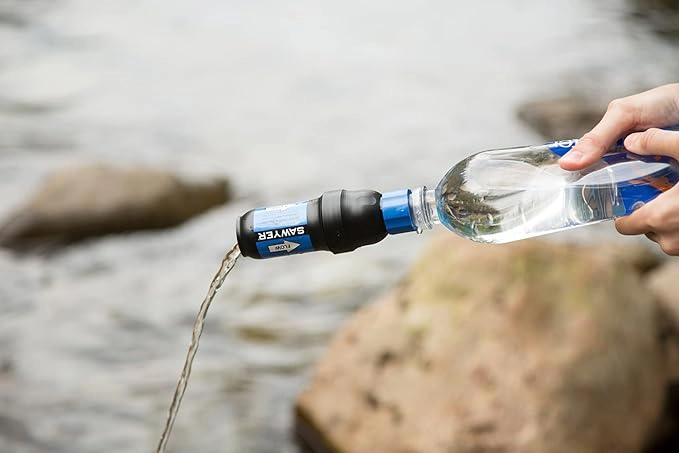
Sawyer
Sawyer Squeeze Water Filtration System
Palm-size 0.1-micron hollow fiber filter that threads onto standard 28 mm bottles. The kit adds two pouches, gravity tubing, inline adapters, and a cleaning plunger.
- 0.1 micron absolute hollow fiber membrane
- Fits standard 28 mm bottle threads
- Filter weighs 3 oz; full kit 8.19 oz
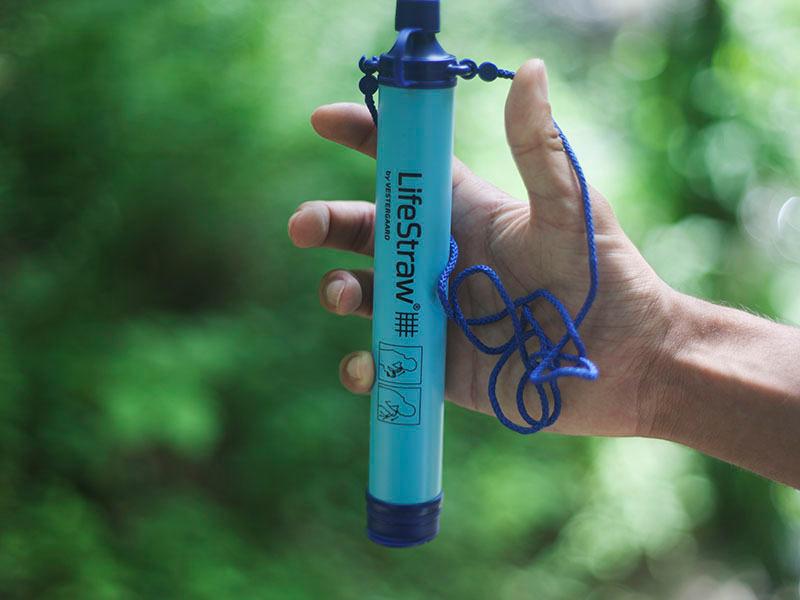
LifeStraw
LifeStraw Personal Water Filter Straw
Straw-style 0.2-micron filter rated for up to 1,000 gallons (4,000 liters). Weighs 1.6 oz and has unlimited shelf life when unused and stored properly.
- 0.2 micron membrane microfilter
- Up to 1,000 gallons / 4,000 liters
- 1.6 oz (46 g), 9 x 1.2 in
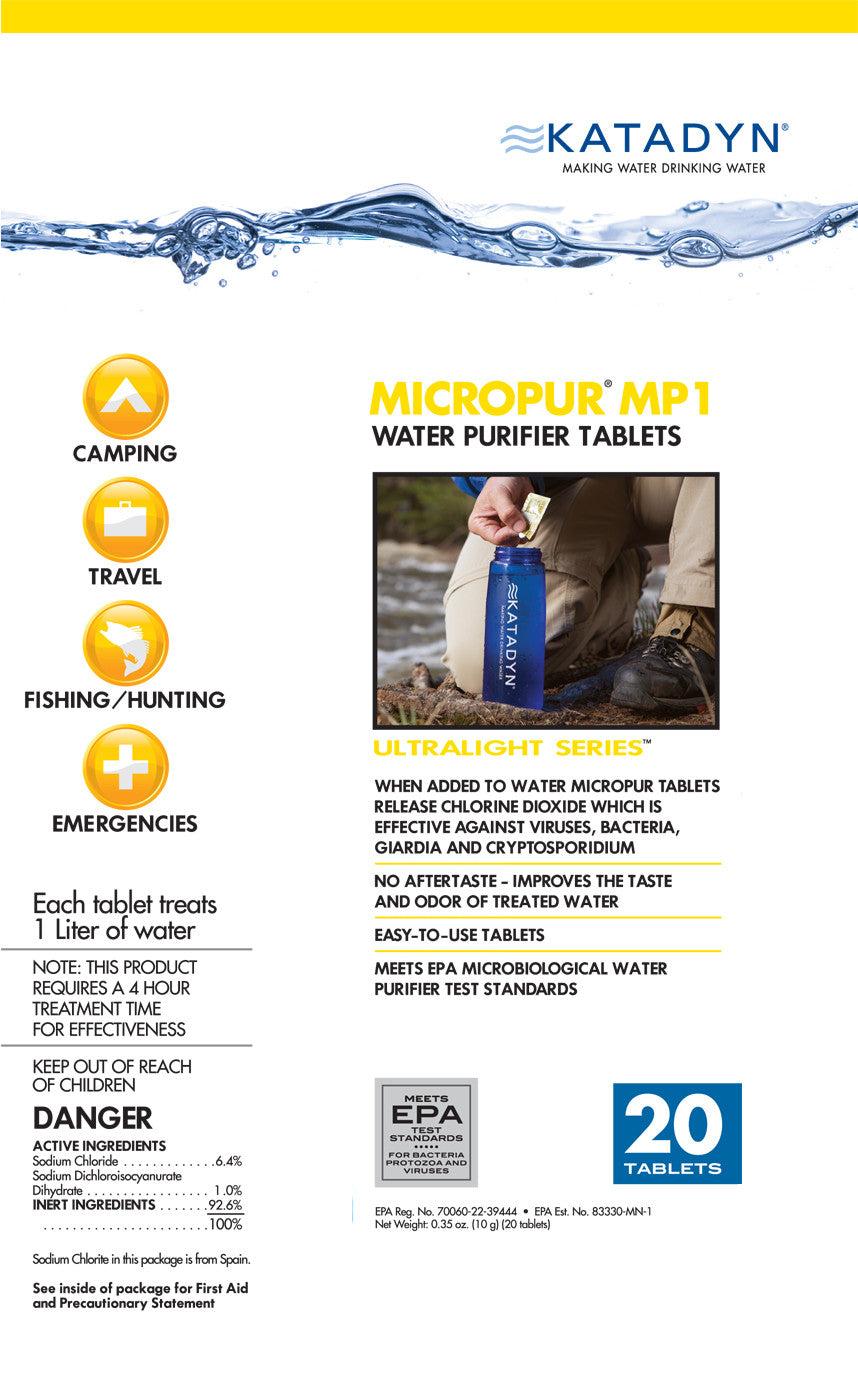
Katadyn
Katadyn Micropur MP1 Water Purifier Tablets (30 Tab)
Chlorine dioxide tablets for tap or clear water. One tablet treats 1 liter with a 4-hour exposure time, so the 30-tablet pack treats up to 30 liters.
- 30 tablets, 1 liter each
- Effective against bacteria, protozoa, cysts, and viruses (Katadyn)
- 4-hour exposure time
$17.95
Backordered· checked
Available for backorder.
Get water and food storage checklists by email
Rotation reminders, storage guides, and what changed in official preparedness guidance.
What to do next
Start with one week of water for everyone in your home, then build to two. Water is one part of a plan: the two-week household preparedness plan puts it alongside food, power, and sanitation, and emergency food buckets vs. a grocery reserve covers the food side. If you would stay put during an outage, work through the shelter-in-place checklist; if you might leave, the evacuation bag list covers water you can carry.