Emergency food buckets vs. building a grocery-store reserve
For most households, a rotating grocery reserve should come first: it costs far less per calorie, it is food you already eat, and you can start this week. Emergency food buckets earn their place for long-term, no-rotation storage. Here are the trade-offs, USDA storage guidance, and a plan to build a reserve gradually.
By Aditya BawankuleUpdated
Disclosure: This page contains affiliate links. We may earn a commission on purchases at no cost to you. Read the disclosure
Should you buy an emergency food bucket or build a grocery reserve?
Build a grocery reserve first, then add a bucket if you need food that can sit for decades. A reserve of canned and dry staples is cheaper, uses food your household already likes, and can be on the shelf this weekend. An emergency food bucket, the stackable pail of freeze-dried or dehydrated pouches sold by brands like Mountain House, ReadyWise, and Augason Farms, costs more but asks almost nothing of you after purchase.
The two solve different problems. A grocery reserve handles the common emergencies: a storm, a week-long outage, a supply disruption that empties shelves for a while. A bucket covers the rarer case where you need food that keeps for years without anyone tending it, at a vacation home or for a relative who will not rotate a pantry.
| Factor | Emergency food bucket | Grocery-store reserve |
|---|---|---|
| Cost per calorie | Several times the cost of grocery staples | Lowest; mostly money you would spend on food anyway |
| Shelf life | Up to 25 to 30 years by maker claim | About 1 to 5 years depending on the food (USDA) |
| Rotation | Buy, store, check occasionally | Must be eaten and replaced, first in, first out |
| Space | Compact and stackable for the calories | Bulkier and heavier, especially canned goods |
| Water and fuel | Needs water for every meal; many need cooking | Canned food can be eaten cold from the can; dry staples need water and heat |
| Taste and variety | A fixed set of recipes, often 5 to 16 | Whatever your household already likes to eat |
| Availability | Several brands sold out or shipping in weeks (Nov 2026) | Buy this week at any grocery store |
Cost: how much more do emergency food buckets cost?
Much more per calorie. At brand-store prices on November 17, 2026, the emergency food kits in our comparison ranged from $4.73 to $21.90 per 1,000 calories. A 20 lb bag of store-brand white rice came to $0.36, so even the cheapest kit cost about 13 times as much per calorie as plain rice.
Rice alone is not a diet, and canned meat, vegetables, and fruit cost more per calorie than rice. But a grocery reserve has a second advantage: you eat it. Every can you rotate out becomes a normal meal, so the money is not tied up in food you hope never to open. The full kit-by-kit numbers, including calories per day and water needed, are in our emergency food comparison.
Shelf life: decades vs. a few years
Buckets win on shelf life. Freeze-dried and dehydrated kits claim up to 25 years, and Mountain House offers a 30-Year Taste Guarantee. Grocery staples last a few years at most, according to the storage chart from USDA's Food Safety and Inspection Service (FSIS).
Short shelf life only costs you if the food sits unused. In a rotating reserve, nothing should be on the shelf longer than a year or two. Storage temperature matters for both: FSIS shows MREs lasting 7 years or more at 60°F but only about a month at 120°F, and FSIS warns that heat over 100°F is harmful to canned goods too.
| Food | Storage on the shelf | Source |
|---|---|---|
| High-acid canned goods (tomatoes, fruit, juices, pickles) | 12 to 18 months | USDA FSIS |
| Low-acid canned goods (meat, poultry, stews, soups other than tomato, beans, vegetables) | 2 to 5 years | USDA FSIS |
| Rice and dried pasta | 2 years | USDA FSIS |
| Commercially packaged jerky | 12 months | USDA FSIS |
| MREs stored at 70°F | 4 1/2 years | USDA FSIS |
| Freeze-dried and dehydrated emergency kits | Up to 25 to 30 years, by maker claim | Manufacturers |
| Ration bars (SOS, Datrex) | 5 years from manufacture | Manufacturers |
USDA notes that, except for infant formula and some baby food, dates on food are for quality, not safety. A shelf-stable product can be used after its sell-by date; after a use-by date it is still safe but may not be at its best quality.
Storage space and weight
Buckets pack more calories into less space. Freeze-drying removes water, so a kit is mostly food you rehydrate later. A Mountain House Classic bucket weighs 5.52 lbs; ReadyWise's 120-serving bucket is 20 lbs; Legacy's 120-serving entree bucket is 29 lbs and takes 1.59 cubic feet; My Patriot Supply's 4-week kit is two buckets weighing 31.65 lbs together. All are designed to stack.
Canned goods are heavier and bulkier because they carry their water with them. That is also their advantage: the water is already in the food. Dry staples like rice, oats, and pasta are the space-efficient part of a grocery reserve. A sturdy shelf in a closet or an interior room usually beats a garage, for the temperature reasons below.
Rotation: first in, first out
A grocery reserve only works if you rotate it. First in, first out (FIFO) means eating the oldest items first and putting new purchases behind them, so nothing expires on the shelf. USDA's FSIS advises checking your pantry every few weeks and using canned goods you have had on hand for a while.
- Write the purchase month on each can or box with a marker.
- Load new items at the back of the shelf and cook from the front.
- Stock only foods you already eat, so rotation happens through normal meals.
- Set a recurring reminder to look over the shelf, such as the first weekend of each season.
Buckets skip most of this. The trade-off is that a bucket you never open is food you have never tasted, and a kit nobody in the house likes is a weak plan.
Food storage temperature and safety (USDA and FEMA guidance)
Store all shelf-stable food in a cool, dry place, ideally below 85°F. That is the guidance from USDA's Food Safety and Inspection Service, which also says high temperatures over 100°F are harmful to canned goods. FSIS advises never storing food above or beside the stove, under the sink, in a damp garage or basement, or anywhere exposed to temperature extremes.
For power outages, FEMA's Ready.gov notes that a refrigerator keeps food cold for about four hours if it stays closed, and that perishable food above 40°F for two hours or more should be discarded. That is the reason a reserve should lean on foods that never needed refrigeration.
Water and fuel needs
Canned food and other ready-to-eat staples, such as peanut butter and dry cereal, are the grocery foods you can eat without water or heat. Ready.gov notes that commercially canned food may be eaten out of the can without warming. Dry staples like rice and pasta need water and a heat source; rice takes 2 cups of water per cup of rice and about 15 minutes of simmering.
Every emergency food bucket needs water too, from 18 cups for a small Mountain House bucket to 12 gallons for Augason Farms' 30-day kit, and many need cooking in a pot. Count that water on top of the gallon per person per day Ready.gov recommends for drinking and sanitation. Our guide to water storage containers covers how to store it. If you cook during an outage, Ready.gov says charcoal grills and camp stoves are for outdoor use only.
Taste, variety, and menu fatigue
A grocery reserve wins on taste because it is food you chose. Ready.gov's first advice for emergency food is to choose foods your family will eat, and its suggested list includes comfort and stress foods.
Buckets offer a fixed menu. The Mountain House Classic bucket has 5 recipes; Augason Farms' 30-day kit has 10 varieties; ReadyWise's 120-serving bucket and the 4Patriots 4-week kit have 11 each; My Patriot Supply lists 16 food and drink varieties. Eating the same handful of meals for weeks wears on people, so if you buy a kit, buy a small one first and taste it.
Allergies and dietary needs
A grocery reserve is easier to fit to allergies and special diets, because you choose every item. Ready.gov advises remembering special dietary needs and including food for infants if you have them.
Bucket kits mix allergens across recipes. Mountain House's Classic bucket includes milk, wheat, egg, soy, sesame, and coconut across its recipes, and most Augason Farms 30-day recipes contain milk. Gluten-free options exist: Mountain House sells a gluten-free Essential Assortment Bucket, Legacy sells a gluten-free entree bucket, and two of ReadyWise's 120-serving bucket recipes are labeled gluten free. Read every pouch's allergen line before you rely on a kit.
How to build a grocery reserve gradually
Add a few extra shelf-stable items to every grocery trip, and in a couple of months you will have weeks of food without a large one-time cost. Start with food that needs no cooking, then add staples.
- First trips: no-cook food for several days. Ready.gov suggests ready-to-eat canned meats, fruits, and vegetables, protein or fruit bars, dry cereal or granola, peanut butter, dried fruit, canned juice, and shelf-stable milk. Buy a manual can opener.
- Next: staples that stretch. Rice, pasta, oats, and dried or canned beans add cheap calories once you have water and a way to cook.
- Then: rotate. Date everything, shelve new items in back, and cook from the front.
- Finally: decide on long-term storage. If you want food that keeps for decades, or a supply for a car or second location, add a bucket kit or ration bars.
For a day-by-day version of this plan, see our two-week household preparedness plan and the shelter-in-place checklist.
Grocery reserve and bucket picks
Purchases through these links support the site at no extra cost to you. (?)
Great Value
Great Value Long Grain Enriched Rice, 20 lb
A 20 lb (9.07 kg) bag of enriched long-grain white rice from Walmart's store brand, 160 calories per 1/4-cup dry serving. Simmer 15 minutes, 2 cups water per cup of rice.
- 20 lb bag, 160 calories per 45 g serving
- 2 cups water per cup of rice
- Gluten-free, kosher
$11.57
In stock· checked
Shipping, arrives Thu, Nov 19
My Patriot Supply
My Patriot Supply 4-Week Emergency Food Supply (2,000+ calories/day)
Two stackable buckets with 250 servings and 56,460 calories, averaging 2,000+ calories a day for one person for four weeks. Add water and heat.
- 56,460 calories in 250 servings
- 9.14 gallons of water to prepare
- Up to 25-year shelf life
$277.95
In stock· checked
Due to unprecedented order volume, orders may take up to 14 business days to ship unless otherwise noted on the product page.
Augason Farms
Augason Farms 30-Day 1-Person Emergency Food Supply Kit, 194 Servings
A 23-pouch pail of breakfasts, entrees, and a whey milk drink rated at 1,290 calories a day for 30 days. Meals are cooked with water for 12 to 15 minutes.
- 194 servings, 1,290 calories per day
- 12 gallons of water to prepare
- Up to 25-year shelf life
$182.99
In stock· checked
Orders containing this item are currently scheduled to ship in December.
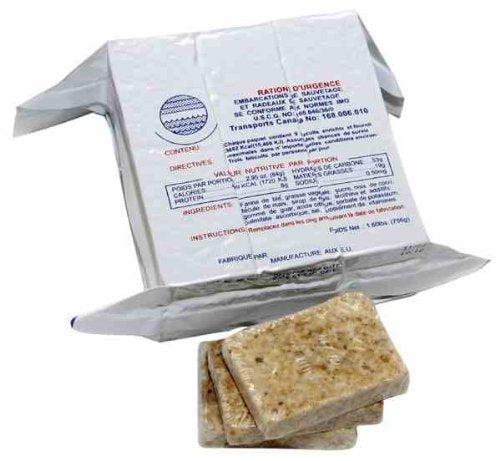
SOS
SOS Emergency Food Ration Bar (3,600 Calorie)
3,600-calorie bar split into nine 400-calorie wafers, eaten three per person per day. 5-year shelf life, U.S. Coast Guard approved, no water or cooking needed.
- Nine 400-calorie wafers (3,600 total)
- 5-year shelf life from manufacture
- Stores from -22 F to 149 F
$6.50
Backordered· checked
In stock soon. Order now to get in line. First come first served.
Get food storage and availability updates
What changed, what it means for your pantry, and what is worth doing about it.