Prepping on a Budget: Your First $100, $300, and $1,000
Do the free steps first: store tap water, write a contact list, copy your documents, and turn on alerts. Then spend in priority order. For one adult, the lists below come to $90.65, $297.52, and $877.77, each building on the one before it.
By Aditya BawankuleUpdated
Disclosure: This page contains affiliate links. We may earn a commission on purchases at no cost to you. Read the disclosure
What to buy first on a small preparedness budget
Buy in the order that keeps you safe longest: water, food, light, first aid, and a way to get information, then backups and comfort. Ready.gov's basic kit list (water, food, a radio, a flashlight, first aid, extra batteries, and phone power) is the backbone of every list here, and most of the expensive gear can wait.
Each tier is cumulative. The $300 list includes everything on the $100 list, and the $1,000 list includes both. The lists are sized for one adult: gear like a radio or lantern is shared by a household, while water and food scale with the number of people. Totals are calculated from the prices on the product cards and are based on prices checked on the dates shown in each table, so expect some movement.
| Budget | What it adds | Running total |
|---|---|---|
| First $100 | Three days of food, headlamps, first aid kit, phone power bank | $90.65 |
| First $300 | Water jug, water filter, weather radio, batteries, CO alarm, lantern, one week of food | $297.52 |
| First $1,000 | Two weeks of water and food, power station, two-way radios, toilet bucket, document bag, fire extinguisher | $877.77 |
Free steps before you spend anything
The most important preparedness steps cost nothing: storing water you already pay for, knowing how to reach your family, and keeping copies of the documents you would need to recover. Do these first, because no purchase replaces them.
| Step | How |
|---|---|
| Store tap water | Wash food-grade containers with soap, sanitize them with 1 teaspoon of unscented bleach per quart of water, fill, label with the date, and replace every six months (CDC). |
| Keep unscented bleach | CDC advises keeping unscented household bleach (5% to 9% sodium hypochlorite) to disinfect water and surfaces. Most homes already have a bottle. |
| Write a contact list | Use Ready.gov's free family communication plan. Store phone numbers somewhere besides your phone, on paper and digitally. |
| Copy key documents | IDs, insurance policies, and bank records, saved electronically or in a waterproof, portable container (Ready.gov). |
| Turn on alerts | Check that Wireless Emergency Alerts are enabled on your phone, sign up for your local alert system, and consider the free FEMA App. |
| Shop your own pantry | Count the canned and dry food you already have, then add one extra item you normally eat each time you shop (Ready.gov). |
| Ask the fire department | Ready.gov notes that local fire departments may have programs that provide smoke or carbon monoxide detectors. |
For water, CDC recommends at least 1 gallon per person per day for three days, and a two-week supply if possible. Unopened store-bought bottled water is the most reliable option; refilled containers work if they are food-grade and sanitized first. The water storage containers guide compares jugs, bricks, and barrels, and the communications and payment outages guide covers keeping some cash and paper contacts for when phones and card readers are down.
Your first $100: food, light, first aid, and phone power
Your first $100 should buy three days of shelf-stable food, a hands-free light, a basic first aid kit, and a power bank, with water covered by the free tap-water step above. That combination handles the most common emergency, a power outage of a few days, for one person.
Food comes first in spending because water storage can start free. Choose foods that need no refrigeration, cooking, or water, the way Ready.gov recommends: canned meats, fruits, and vegetables, peanut butter, protein bars, dry cereal, and a manual can opener if you do not own one. The grocery line in the table is a typical cost from USDA's Thrifty Food Plan, not a specific product; your store and choices will vary.
You may already own: flashlights, a manual can opener, bandages and pain relievers, camping gear, and a car charger for your phone. Skip anything you already have and move that money to the next item.
First $100: purchase links
Purchases through these links support the site at no extra cost to you. (?)
Energizer
Energizer Universal LED Headlamp, 2-Pack
Two lightweight AAA headlamps with a 100-lumen white beam and a red night-vision mode. Batteries are included.
- Two headlamps in one pack
- 100 lumens, 40-meter beam distance
- IPX4 water resistant
$14.02
In stock· checked
BAND-AID
BAND-AID Brand All-Purpose Portable Compact First Aid Kit, 160 Piece
A 160-piece minor wound care kit in a refillable plastic case: bandages, gauze, cleansing wipes, antibiotic and anti-itch cream, and pain relief.
- 160 pieces of first aid supplies
- Refillable hard plastic case
- Latex-free adhesive bandages
Anker
Anker PowerCore Slim 10000 Power Bank (USB-C, 10,000mAh, A1229)
Slim 10,000mAh power bank with a two-way USB-C port. Anker rates it at about two full charges for an iPhone 15.
- 10,000mAh capacity
- Two-way USB-C charging
- 8.6 oz, 0.61 in thick
| Item | Purpose | Price checked | Price |
|---|---|---|---|
| Groceries, 3 days (typical cost) | Three days of no-cook, shelf-stable food from the grocery store | USDA Thrifty Food Plan, Sept. 2026 | $37.85 |
| Energizer Universal LED Headlamp, 2-Pack | Hands-free light, two lamps | 2026-11-17 | $14.02 |
| BAND-AID Brand All-Purpose Portable Compact First Aid Kit, 160 Piece | Minor cuts, burns, and pain relief | 2026-11-17 | $17.90 |
| Anker PowerCore Slim 10000 Power Bank (USB-C, 10,000mAh, A1229) | Keeps a phone charged for alerts and calls | 2026-11-17 | $20.88 |
| Total so far | $90.65 |
Your first $300: water storage, a weather radio, and backups
The next step to $300 adds dedicated water storage, a portable water filter, a NOAA weather radio, spare batteries, a battery-powered carbon monoxide alarm, a lantern, and enough food to reach one week. This is the point where you can ride out a longer outage without depending on your phone.
A 5-gallon food-grade jug holds five days of water for one person at CDC's one-gallon rate. The LifeStraw filter is for water you have to collect or carry, such as during an evacuation; it removes bacteria and parasites but, per LifeStraw, not chemicals or heavy metals. For water at home, CDC's bleach method below works with no filter at all.
Ready.gov lists a battery-powered or hand-crank radio and a NOAA Weather Radio with tone alert in its basic kit, and the Midland ER10 covers both. The carbon monoxide alarm matters because outages are when people start running generators, grills, and camp stoves; CDC advises battery-operated or battery-backup CO alarms near every sleeping area. The lantern runs on three AA batteries from the battery pack, or on three D batteries, which Energizer lists for maximum performance.
Added at $300: purchase links
Purchases through these links support the site at no extra cost to you. (?)
Scepter
Scepter Flow Control 5 Gallon Water Jug (WCG501ECOM)
Rigid, food-grade, BPA-free 5-gallon water can with a flow control spout that pours while the jug lies on its side.
- 5-gallon capacity
- Food-grade, BPA-free plastic
- Adjustable flow control valve
$34.99
Backordered· checked
Usually ships within 1 to 2 months
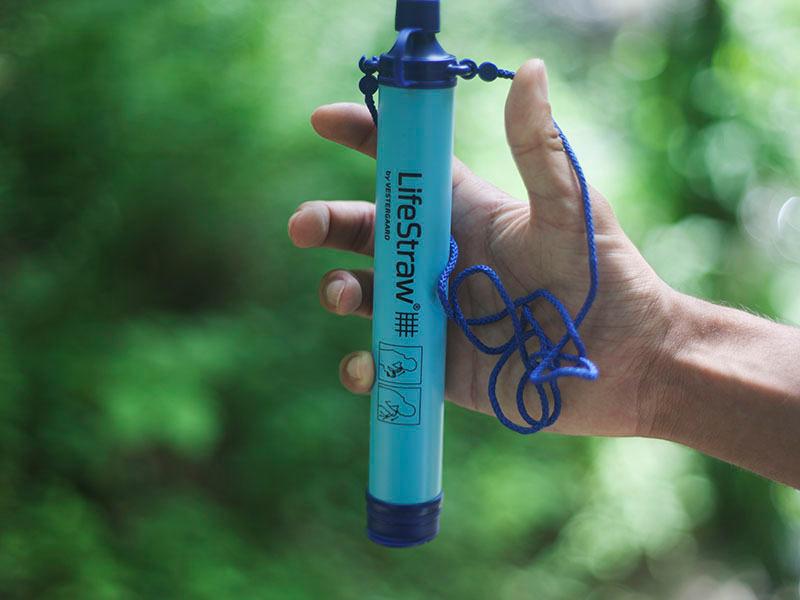
LifeStraw
LifeStraw Personal Water Filter Straw
Straw-style 0.2-micron filter rated for up to 1,000 gallons (4,000 liters). Weighs 1.6 oz and has unlimited shelf life when unused and stored properly.
- 0.2 micron membrane microfilter
- Up to 1,000 gallons / 4,000 liters
- 1.6 oz (46 g), 9 x 1.2 in
Midland
Midland ER10VP Compact Emergency Alert AM/FM Weather Radio
Pocket-size NOAA weather alert radio with AM/FM, an LED flashlight with SOS strobe, and a wrist lanyard; runs on three AA batteries, which are included.
- NOAA Weather Radio with visual and audio alerts
- AM/FM radio and LED flashlight
- 5 x 3 x 1.2 in; 3 AA batteries included
Amazon Basics
Amazon Basics AA and AAA Alkaline Batteries, 48-Count (24 AA, 24 AAA)
Value pack of 24 AA and 24 AAA single-use 1.5-volt alkaline batteries.
- 24 AA and 24 AAA in one pack
- 1.5-volt alkaline
- Ships from and sold by Amazon
Kidde
Kidde Battery-Operated Carbon Monoxide Alarm (KN-COPP-B-LPM)
Portable carbon monoxide alarm that runs on two AA batteries, so it keeps detecting during a power failure. Wall mount or tabletop.
- Runs on 2 AA batteries (included)
- Electrochemical CO sensor, 85 dB alarm
- Peak level memory
Energizer
Energizer WeatheReady PRO-360 LED Camping Lantern
Battery-powered 360-degree LED area lantern rated at 500 lumens that runs on either three D or three AA batteries, with IPX4 water resistance.
- 500 lumens on high
- 360-degree area light
- Runs on 3 D or 3 AA batteries
| Item | Purpose | Price checked | Price |
|---|---|---|---|
| Everything on the $100 list | Carried over | $90.65 | |
| Scepter Flow Control 5 Gallon Water Jug (WCG501ECOM) | Five days of stored water for one person | 2026-11-17 | $34.99 |
| LifeStraw Personal Water Filter Straw | Filters bacteria and parasites if you must leave or use untreated water | 2026-11-17 | $17.95 |
| Midland ER10VP Compact Emergency Alert AM/FM Weather Radio | NOAA weather alerts and AM/FM news without cell service | 2026-11-17 | $39.99 |
| Amazon Basics AA and AAA Alkaline Batteries, 48-Count (24 AA, 24 AAA) | Spares for the headlamps, radio, CO alarm, and lantern | 2026-11-17 | $16.70 |
| Kidde Battery-Operated Carbon Monoxide Alarm (KN-COPP-B-LPM) | Battery-powered carbon monoxide alarm that works in an outage | 2026-11-17 | $27.79 |
| Energizer WeatheReady PRO-360 LED Camping Lantern | Room light for evenings without power | 2026-11-17 | $18.98 |
| Groceries, 4 days (typical cost) | Four more days of food, for one week in total | USDA Thrifty Food Plan, Sept. 2026 | $50.47 |
| Total so far | $297.52 |
Your first $1,000: two weeks of supplies and backup power
Reaching $1,000 extends water and food to two weeks, the supply CDC suggests storing if you can, and adds a battery power station, two-way radios, a toilet bucket, a waterproof document bag, and a fire extinguisher. It turns a three-day kit into a two-week household plan.
Three 5-gallon jugs hold 15 gallons, a two-week supply for one adult at one gallon a day. The Jackery Explorer 300 recharges phones, the radios, and lights many times between wall charges, and Jackery describes it as producing no fumes, so it avoids the carbon monoxide risk of a fuel generator. The Midland T51 radios need no license and keep a household in touch across short distances when cell service is down.
The toilet bucket covers a gap most households never plan for: plumbing that cannot be used. Pair it with heavy-duty trash bags and plastic ties, which are on Ready.gov's basic kit list. The document bag holds the paper copies from the free steps, and a fire extinguisher is on Ready.gov's list of additional supplies.
You may already own: sleeping bags or warm blankets, a cooler, storage bins for organizing supplies, and outdoor cooking gear. Ready.gov notes that charcoal grills and camp stoves are for outdoor use only.
Added at $1,000: purchase links
Purchases through these links support the site at no extra cost to you. (?)
Scepter
Scepter Flow Control 5 Gallon Water Jug (WCG501ECOM)
Rigid, food-grade, BPA-free 5-gallon water can with a flow control spout that pours while the jug lies on its side.
- 5-gallon capacity
- Food-grade, BPA-free plastic
- Adjustable flow control valve
$34.99
Backordered· checked
Usually ships within 1 to 2 months
Jackery
Jackery Explorer 300 Portable Power Station (292Wh LiFePO4)
7.5 lb portable power station with a 292Wh LiFePO4 battery, two AC outlets, 100W USB-C, and a 300W rated (600W peak) output.
- 292Wh LiFePO4 battery
- 2 AC outlets, 100W USB-C, 2 USB-A, car port
- 7.5 lb
Midland
Midland T51 X-Talker FRS Walkie Talkie 2-Pack (T51VP3)
License-free FRS two-way radio pair with 22 channels, NOAA weather alert, and AAA battery backup. A simple way to keep a household in touch across a neighborhood when phones are down.
- FRS: no license required
- 22 channels, 38 privacy codes
- NOAA weather radio and alert
Camco
Camco Portable Toilet Bucket with Snap-On Seat and Lid, 5 Gallon (41549)
A 5-gallon toilet bucket with a snap-on seat and lid, a carry handle, and three bag liners: the core of a bucket toilet when the plumbing can't be used.
- 5-gallon bucket with snap-on seat and lid
- Includes 3 disposable bag liners
- Smooth interior and built-in carry handle
$32.99
Backordered· checked
Usually ships within 1 to 4 weeks
LOKSAK
aLOKSAK Waterproof Bag 13x11 Inch (2 Pack)
Resealable waterproof bags certified to 200 feet, sized to hold letter-size documents flat. Keeps paper copies of IDs, insurance, and contact lists dry in a kit or go bag.
- Certified waterproof to 200 feet
- Inner size 12.75 x 11 inches
- Airtight resealable closure
First Alert
First Alert HOME1 Rechargeable Fire Extinguisher (FE1A10GR)
UL-rated 1-A:10-B:C multipurpose home fire extinguisher with an all-metal valve and trigger and a color-coded pressure gauge.
- UL rated 1-A:10-B:C
- Commercial-grade metal valve and trigger
- Rechargeable by a certified professional
| Item | Purpose | Price checked | Price |
|---|---|---|---|
| Everything on the $300 list | Carried over | $297.52 | |
| Scepter Flow Control 5 Gallon Water Jug (WCG501ECOM) (x2) | Two more jugs: about two weeks of stored water in total | 2026-11-17 | $69.98 |
| Jackery Explorer 300 Portable Power Station (292Wh LiFePO4) | Recharges phones, lights, and radios through a multi-day outage | 2026-11-17 | $289.00 |
| Midland T51 X-Talker FRS Walkie Talkie 2-Pack (T51VP3) | License-free two-way radios for when phones are down | 2026-11-17 | $59.99 |
| Camco Portable Toilet Bucket with Snap-On Seat and Lid, 5 Gallon (41549) | Bucket toilet for when plumbing cannot be used | 2026-11-17 | $32.99 |
| aLOKSAK Waterproof Bag 13x11 Inch (2 Pack) | Waterproof storage for document copies and a contact list | 2026-11-17 | $16.99 |
| First Alert HOME1 Rechargeable Fire Extinguisher (FE1A10GR) | Multipurpose home fire extinguisher | 2026-11-17 | $22.98 |
| Groceries, 7 days (typical cost) | One more week of food, for two weeks in total | USDA Thrifty Food Plan, Sept. 2026 | $88.32 |
| Total so far | $877.77 |
What can wait
Large purchases can wait until the basics are covered: freeze-dried food buckets, fuel generators, large water barrels, solar panels, and specialized survival gear. None of them helps if you lack water, food, light, and a way to get alerts.
When you are ready for them, compare a food bucket against a grocery-store reserve on cost per calorie, and build an evacuation bag from gear you already own before buying new. For a full category-by-category kit at higher budgets, see the emergency preparedness kit builder.
How to scale the lists for your household
Multiply the water and food lines by the number of people, and keep the shared gear as is. One radio, one lantern, one CO alarm per sleeping area, and one power station serve a household; water at one gallon per person per day and food for each person do not.
For a household of four, buy the three days of food for everyone before adding the $300 items, and store enough tap water to cover each person for three days. Add headlamps so every adult has one, and remember medications, pets, infant food, and special diets; Ready.gov's kit and food pages call out pets, seniors, infants, and special dietary needs. The how to start prepping guide walks through assessing those needs, and the printable 72-hour kit checklist makes a shopping list for the store.