Car Emergency Kit Checklist: Year-Round and Seasonal Essentials
A car emergency kit needs two things: tools to get a stalled car moving or noticed (a jump starter or cables, a tire inflator and sealant, warning triangles, a light) and supplies to keep everyone safe while you wait (first aid, water, food, blankets, phone power). Add winter and summer items as the seasons change.
By Aditya BawankuleUpdated
Disclosure: This page contains affiliate links. We may earn a commission on purchases at no cost to you. Read the disclosure
What should be in a car emergency kit?
Keep enough in the car to fix the common problems yourself and to stay safe for several hours if you cannot. Ready.gov's car kit list is short: jumper cables, flares or a reflective triangle, an ice scraper, a car phone charger, a blanket, a map, and cat litter or sand for traction. NHTSA adds a first aid kit that includes a tourniquet, a flashlight, a tire pressure gauge, a jack and ground mat, work gloves, basic tools and duct tape, drinking water, non-perishable food, medicines, and emergency blankets, towels, and coats.
Those lists overlap with a home kit, but the car version is about roadside problems: a dead battery, a flat tire, being hard to see on a dark shoulder, and waiting in heat or cold for help. The checklist below combines the official lists with the tools that solve those problems without a second car.
Car emergency kit checklist
Work through the year-round list once, then add the seasonal items in late fall and late spring. Keep the kit in a bag or bin in the trunk so it does not roll around, and keep the light, phone charger, and first aid kit within reach of the driver's seat.
Breakdown
- Jumper cables or a charged lithium jump starter
- Tire pressure gauge, 12V tire inflator, and a can of tire sealant
- Spare tire checked for pressure, plus the jack and lug wrench
- Reflective warning triangles or flares
- Work gloves, basic tools, and duct tape
People
- First aid kit, including a tourniquet
- Drinking water and non-perishable food, rotated on a schedule
- Personal medicines for everyone who rides regularly
- A blanket or emergency bivvy per seat you usually fill
- A change of clothes and rain gear
Light and communication
- Flashlight or headlamp with spare batteries
- Phone car charger and a charged power bank
- Paper road map of your area
- Paper towels and extra windshield washer fluid
Winter additions
- Snow shovel, snow brush or broom, and ice scraper
- Sand or cat litter for traction
- Warm clothes, hats, and gloves for everyone
- Extra blankets
- Bright cloth to tie to the antenna or door
- Winter washer fluid with de-icer in the reservoir
Summer heat additions
- Extra drinking water for every passenger
- Sun protection: hats and sunscreen
- A shade spot or cooler bag for the jump starter and power bank
- A/C, belts, hoses, and coolant checked before long trips
Leaving home with the car in an evacuation? Use the printable evacuation checklist and pack a go bag for each person.
Dead battery: jumper cables or a lithium jump starter?
Carry a lithium jump starter if you often drive alone, and jumper cables if you want the cheapest option and usually have help nearby. Cables need a second running car parked close enough to reach. A jump starter, a battery pack the size of a thick paperback with clamps attached, restarts the car by itself.
Match the jump starter to your engine using the maker's own rating. NOCO rates the GB40 at 1,000 amps for gas engines up to 6.0 liters and diesel engines up to 3.0 liters; bigger trucks need a larger model. Its clamps are spark-proof and will not deliver power if connected backwards, and a USB port recharges a phone. NOCO says Boost units hold 70% of their charge for up to a year and recommends recharging every 4 to 6 months.
Cold makes batteries weaker. NHTSA notes that gas and diesel engines need more battery power to start in cold weather and recommends having a mechanic check the battery and charging system before winter.
Dead-battery picks
Purchases through these links support the site at no extra cost to you. (?)
NOCO
NOCO Boost Plus GB40 1000A Jump Starter
Compact lithium jump starter rated at 1,000 amps for gas engines up to 6.0 liters and diesel engines up to 3.0 liters, so you can restart a dead battery without a second car.
- 1,000A rating; gas engines up to 6.0L, diesel up to 3.0L
- Spark-proof clamps with reverse polarity protection
- USB port recharges a phone; 100-lumen flashlight
Ready America
Ready America Heavy Duty Jumper Cables (12 ft, 6 gauge)
Twelve-foot, 6-gauge booster cables: the low-cost way to restart a dead battery when another vehicle can give you a jump.
- 12-foot length
- 6-gauge cable
- No charging or battery maintenance
Flat tire: inflator, sealant, and a gauge
A 12-volt tire inflator, a small air compressor that plugs into the car's power outlet, fixes the most common tire problem: a tire that is low or slowly leaking. Pair it with a can of tire sealant for punctures and a gauge to check pressure.
Fix-a-Flat says its sealant closes punctures up to 1/4 inch and adds enough air to lift the rim off the ground. It then tells you to drive 2 to 4 miles and bring the tire up to proper pressure with an air line or inflator, and to see a tire professional for a permanent repair. Choose the can size for your tire: the 16 oz can is for sedans and coupes. NOCO's AIR10 inflator runs on 12 volts, stops automatically at the pressure you set, and is rated to 60 psi.
Inflate to the pressure on the label inside the driver's door frame, not the number molded on the tire, which NHTSA notes is the tire's maximum. Check the spare too, if you have one, and use NHTSA's penny test for tread: if you can see the top of Lincoln's head, the tire needs replacing.
Tire picks
Purchases through these links support the site at no extra cost to you. (?)
NOCO
NOCO AIR10 12V Portable Air Compressor
Metal-bodied 12-volt tire inflator that plugs into the car's power outlet, fills a flat car tire from 0 to 40 psi in 3.8 minutes per NOCO, and shuts off at the pressure you set.
- 0-40 psi in 3.8 minutes (maker's figure)
- Auto-shutoff at a set pressure
- Runs 25 minutes at 30 psi
$99.95
Price checked
Fix-a-Flat
Fix-a-Flat 16 oz. Emergency Flat Tire Repair (Sedan | Coupe)
Aerosol sealant and inflator that seals punctures up to 1/4 inch and adds enough air to get a sedan or coupe moving to a place where you can inflate and repair the tire.
- Seals punctures up to 1/4 inch
- Sized for sedan and coupe tires
- Temporary repair; inflate afterward
Be seen: warning triangles, flares, and light
Reflective warning triangles tell approaching drivers that a car is stopped ahead, and they are on both the Ready.gov and NHTSA lists (as flares or emergency markers). Triangles cannot burn out and have no flame. Look for a set whose maker states compliance with FMVSS 571.125, the federal standard for vehicle warning devices.
A headlamp keeps both hands free for a tire change or jump start. A handheld flashlight that runs on common AA batteries is a useful backup, since spare AAs are sold almost everywhere.
Visibility picks
Purchases through these links support the site at no extra cost to you. (?)
CARTMAN
CARTMAN Foldable Road Safety Warning Triangles (3-Pack)
Three folding reflective triangles that the seller states meet FMVSS 571.125, the federal standard for vehicle warning devices, to warn traffic approaching a stopped car.
- States FMVSS 571.125 compliance
- 17 x 17 in reflective and fluorescent panels
- Sand-fillable weighted base
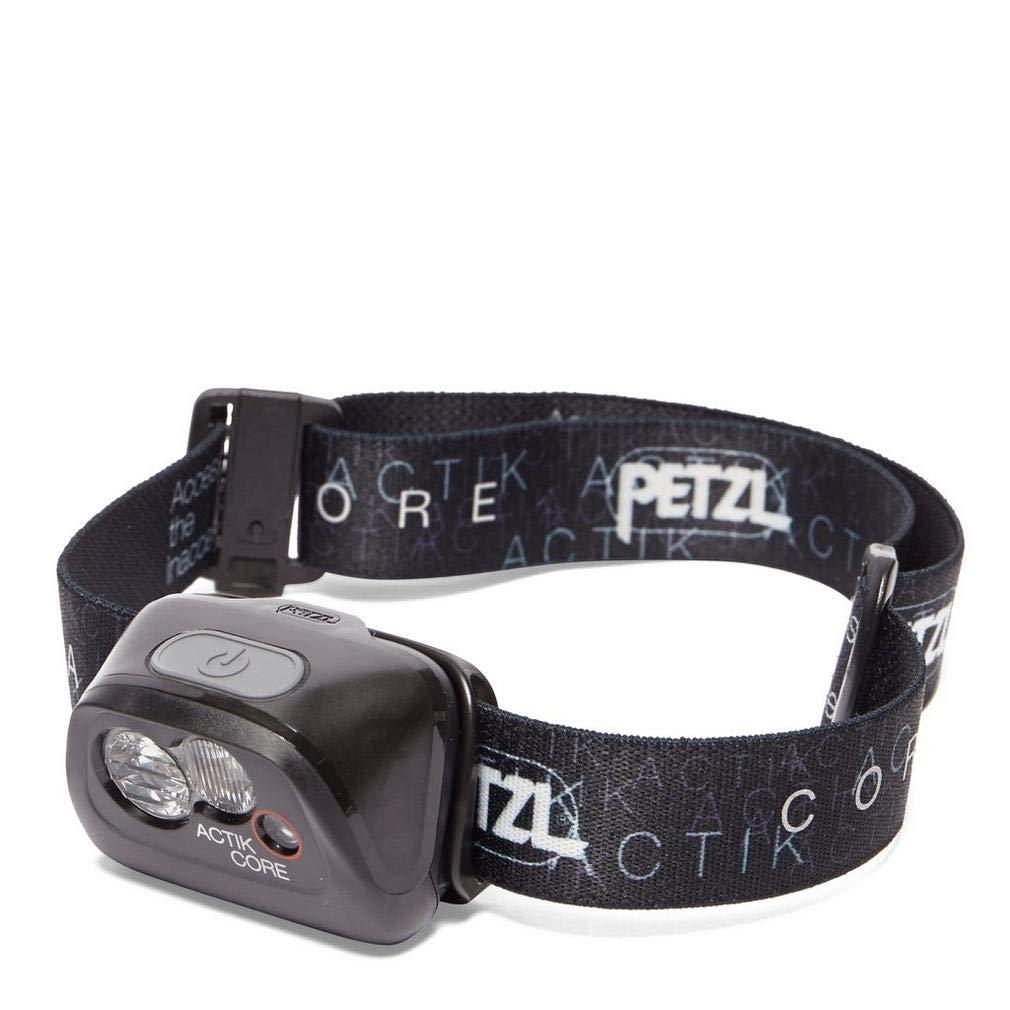
Petzl
Petzl ACTIK CORE Headlamp
625-lumen headlamp that runs on its USB-C rechargeable CORE battery or three AAA batteries. 88 g, IPX4, with a red light mode.
- 625 lumens max (450 on AAA)
- CORE rechargeable battery or 3 x AAA
- 88 g, IPX4, red lighting
$87.95
Price checked
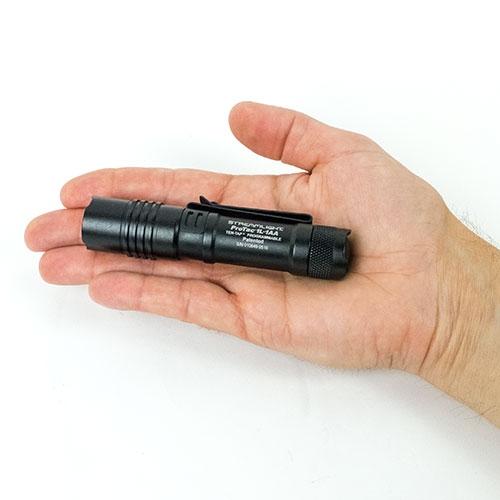
Streamlight
Streamlight ProTac 1L-1AA
4.25-in flashlight that runs on one CR123A (350 lumens) or one AA (150 lumens). Ships with both batteries and a nylon holster.
- 350 lumens on CR123A, 150 on AA
- IPX7 waterproof to 1 m; 2 m impact tested
- CR123A and AA batteries plus holster included
$49.50
Price checked
First aid, water, food, and warmth
The supplies that keep people safe matter as much as the tools that fix the car. NHTSA's winter and summer lists both call for a first aid kit that includes a tourniquet, along with personal medicines, drinking water, non-perishable food, and blankets. A trauma kit such as the North American Rescue IPOK adds a tourniquet and pressure dressing to a standard first aid kit.
Choose food that needs no cooking and tolerates heat and cold, such as ration bars, and keep bottled water for the people who ride with you most. Ready.gov's general planning figure is one gallon of water per person per day. A compact emergency bivvy or a wool blanket for each seat covers warmth if the heater is off.
First aid and comfort picks
Purchases through these links support the site at no extra cost to you. (?)
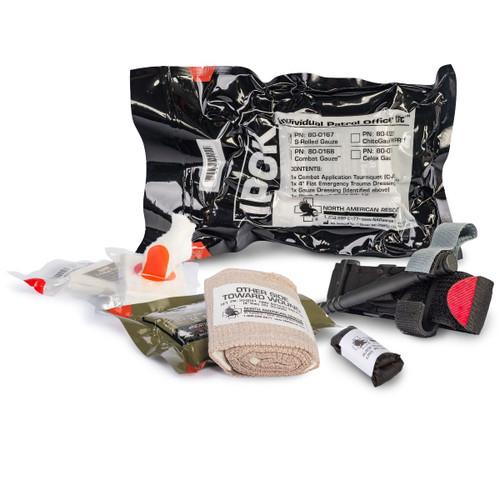
North American Rescue
North American Rescue Individual Patrol Officer Kit (IPOK)
Vacuum-sealed bleeding control kit with a C-A-T tourniquet, wound packing gauze, a 4 in. Flat ETD trauma dressing, and nitrile gloves. 7.4 oz.
- C-A-T (Combat Application Tourniquet)
- Wound packing gauze and 4 in. Flat ETD dressing
- Vacuum sealed, 4 x 6.5 x 2.75 in, 7.4 oz
BAND-AID
BAND-AID Brand All-Purpose Portable Compact First Aid Kit, 160 Piece
A 160-piece minor wound care kit in a refillable plastic case: bandages, gauze, cleansing wipes, antibiotic and anti-itch cream, and pain relief.
- 160 pieces of first aid supplies
- Refillable hard plastic case
- Latex-free adhesive bandages
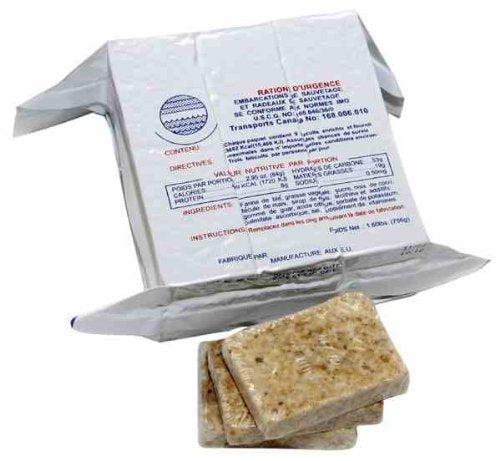
SOS
SOS Emergency Food Ration Bar (3,600 Calorie)
3,600-calorie bar split into nine 400-calorie wafers, eaten three per person per day. 5-year shelf life, U.S. Coast Guard approved, no water or cooking needed.
- Nine 400-calorie wafers (3,600 total)
- 5-year shelf life from manufacture
- Stores from -22 F to 149 F
$6.50
Backordered· checked
In stock soon. Order now to get in line. First come first served.
SOL
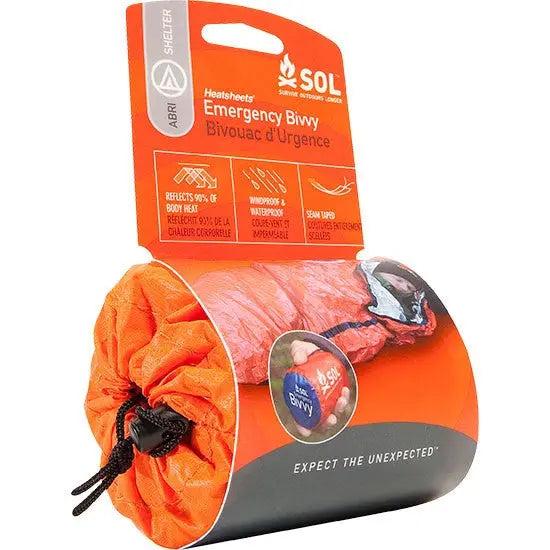
SOL Emergency Bivvy with Rescue Whistle
3.8 oz sealed reflective bivvy, 84 x 36 in, that SOL says reflects 90% of body heat. A tinder-cord drawstring and survival whistle are attached.
- Reflects 90% of body heat (SOL)
- Waterproof, windproof, sealed seams
- 3.8 oz, 84 x 36 in
$24.49
Price checked
Phone charging and communication
A charged phone is the most important item in the car, and NHTSA puts a cell phone and charger at the top of its roadside kit list. Keep a car charger plugged in and a charged power bank in the glove box so you can call for help without idling the engine. A paper map still works when cell service and navigation apps do not.
A NOAA weather radio is worth adding if you drive rural roads or keep the kit ready for evacuations, since it receives alerts without cell service.
Power and communication picks
Purchases through these links support the site at no extra cost to you. (?)
Nitecore
Nitecore NB10000 Gen4 10,000mAh Power Bank
5 oz, 10,000mAh (39Wh) power bank with two USB-C ports, 22.5W fast charging, and an IPX7 water-resistance rating: small enough for a glove box or every go bag in the house.
- 10,000mAh / 39Wh
- Two USB-C ports, 22.5W max
- IPX7 water resistant, 5 oz
Midland
Midland ER10VP Compact Emergency Alert AM/FM Weather Radio
Pocket-size NOAA weather alert radio with AM/FM, an LED flashlight with SOS strobe, and a wrist lanyard; runs on three AA batteries, which are included.
- NOAA Weather Radio with visual and audio alerts
- AM/FM radio and LED flashlight
- 5 x 3 x 1.2 in; 3 AA batteries included
Winter additions and what to do if you are stranded
In winter, add snow and traction tools and enough warm layers to wait out a long delay. NHTSA lists a snow shovel, broom, ice scraper, and sand or kitty litter; Ready.gov adds warm clothes and blankets and says to keep a full tank of gas, which also keeps the fuel line from freezing. NHTSA also recommends filling the washer reservoir with winter fluid that contains de-icer and checking tire pressure, since it drops as the temperature falls.
The best winter rule is not to drive in a storm if you can avoid it. Ready.gov says to stay off the roads if at all possible, and NWS says to let someone know your route before you leave.
| If you are stuck in snow | Why |
|---|---|
| Stay in the vehicle | NWS: you become disoriented quickly in wind-driven snow and cold |
| Run the engine about 10 minutes each hour for heat | NWS guidance for staying warm in a stuck car |
| Crack a window while the engine runs | Fresh air helps prevent carbon monoxide poisoning (NWS) |
| Clear snow from the exhaust pipe | Prevents carbon monoxide poisoning (NWS, NHTSA) |
| Dome light on at night while running; bright cloth on the antenna or door | Makes the car visible to rescuers (NWS, NHTSA) |
| Raise the hood after the snow stops | NWS: signals that you need help |
Summer heat additions
In summer, add more water and make sure the car itself can handle heat. NHTSA recommends checking air conditioning performance and inspecting belts and hoses for bulges, blisters, cracks, or cuts, since heat speeds up rubber wear. A breakdown without A/C is hardest on children and older adults.
Never leave a child or a pet in a parked car. NHTSA says a child's body temperature rises three to five times faster than an adult's, and that even on a 60-degree day with the windows cracked the inside of a car can reach deadly temperatures. Ready.gov gives the same rule for people and pets.
Heat is also hard on the kit. Rotate food and water more often in hot months, and keep lithium devices out of direct sun: NOCO says a car's interior can reach 122 degrees Fahrenheit within 10 minutes, which is the top of its jump starters' storage range.
Prebuilt roadside kit or build your own?
A prebuilt roadside kit is a quick way to get the basics into the car today; building your own gets you better tools for the problems you are most likely to have. Most prebuilt kits are strongest on jumper cables and small first aid supplies and weakest on lighting, tire tools, and anything personal. Neither route includes your water, food, medicines, or phone charger.
Prices in the table are the snapshots shown on the purchase cards. The build-your-own core here is the NOCO Boost Plus GB40 1000A Jump Starter, NOCO AIR10 12V Portable Air Compressor, Fix-a-Flat 16 oz. Emergency Flat Tire Repair (Sedan | Coupe), CARTMAN Foldable Road Safety Warning Triangles (3-Pack), North American Rescue Individual Patrol Officer Kit (IPOK), Petzl ACTIK CORE Headlamp.
| Option | What it covers | What you still add | Price snapshot |
|---|---|---|---|
| Ready America Roadside Essentials Kit | 12 ft booster cables, multi-tool, 33-piece first aid kit, two lightsticks, survival blanket, banner | Flashlight, warning triangles, tire inflator or sealant, water, food, phone charger | $49.99 |
| EVERLIT Survival Car Emergency Kit | 12 ft 8-gauge cables, 12V digital inflator, warning triangle, 108-piece first aid kit, flashlight, tow rope | Water, food, blanket, phone charger, medicines; a jump starter if you drive alone | $62.96 |
| Build-your-own core | Jump starter, 12V inflator, sealant, three triangles, trauma kit with tourniquet, headlamp | Water, food, blanket, phone charger, medicines, gloves and tools you already own | $390.21 |
Prebuilt roadside kits
Purchases through these links support the site at no extra cost to you. (?)
Ready America
Ready America 70350 Roadside Essentials Kit
Budget prebuilt roadside kit: 12-foot booster cables, a multi-tool, a 33-piece first aid kit, two 8-hour lightsticks, a survival blanket, and an emergency banner in a carry case with room to add your own items.
- 12-foot booster cables
- 33-piece first aid kit
- Room in the case to add items
EVERLIT
EVERLIT Survival Car Emergency Kit with Digital Tire Inflator
Prebuilt roadside bag that adds a 12V digital tire inflator, a reflective warning triangle, and a 108-piece first aid kit to 12-foot, 8-gauge jumper cables, a tow strap, and a flashlight.
- 12V digital inflator with auto-shutoff
- 12 ft, 8-gauge jumper cables
- Warning triangle and 108-piece first aid kit
Get the car itself ready
The kit helps after something goes wrong; maintenance prevents most of it. Ready.gov suggests having a mechanic check antifreeze, the battery and ignition, brakes, exhaust, fuel and air filters, the heater and defroster, lights and hazard flashers, oil, the thermostat, and wipers and washer fluid. NHTSA also recommends looking up open safety recalls for your vehicle by VIN.
Keep at least a half tank of gas at all times, as Ready.gov recommends, because stations may be closed during emergencies and cannot pump during power outages. And never drive into floodwater: Ready.gov says six inches of water can cause a car to lose control or stall, and a foot of water will float many cars.
Get seasonal kit reminders by email
Winter and summer kit checks, what changed in official guidance, and what is worth doing about it.