Travel Emergency Kit: What to Carry When a Trip Goes Wrong
At about 3:30 p.m. ET on November 13, 2026, the FAA issued a nationwide ground stop, and air traffic did not resume until 8:15 p.m. A travel emergency kit is what you keep on you or in your carry-on for a stranded evening like that one, or the night after a canceled flight: a power bank under the FAA's 100 Wh limit, copies of your documents, cash, enough medication for delays, a compact first aid kit, a light, water and food, and a warm layer, all packed within TSA rules.
By Aditya BawankuleUpdated
Disclosure: This page contains affiliate links. We may earn a commission on purchases at no cost to you. As an Amazon Associate we earn from qualifying purchases. Read the disclosure
What should be in a travel emergency kit?
A travel emergency kit should keep your phone charged, your documents replaceable, and your medications on hand when a trip stops moving. Carry a power bank, printed and digital copies of your documents, cash, every medication you take plus a few extra days, a compact first aid kit, a headlamp or flashlight, an empty water bottle and packaged food, and a warm layer.
The FAA says a technical problem led to the November 13 ground stop; about 12,462 flights were canceled that day, including 9,082 by major airlines, though the FAA says not all of those were directly caused by the stop. The FAA says it has no indication that this was a cyberattack. Read what the FAA has said about the ground stop.
Ready.gov's reasoning for home kits applies on the road: "Since you do not know where you will be when an emergency occurs, prepare supplies for home, work and cars." Its basic kit includes a flashlight, a first aid kit, a whistle, a dust mask, local maps, and a cell phone with chargers and a backup battery, plus prescription medications, cash, and important documents. The CDC's Pack Smart list for travelers covers document copies, medicines, and health supplies, and the State Department adds offline maps and a portable battery. The checklist below combines those lists.
Power and phone
- Phone and charging cable
- Charged power bank under 100 Wh, in the carry-on
- Offline maps downloaded for every stop
Documents and money
- Copies of your passport and travel documents, printed and on your phone
- Contact card for a family member or close contact
- Lodging details and U.S. embassy or consulate contacts
- Health insurance card and copies of prescriptions
- A spare passport photo for trips abroad
- Cash
Health
- Every medication you take, plus a few extra days, in original packaging
- Doctor's letter listing prescriptions by generic name
- Compact first aid kit
- Hand sanitizer with at least 60% alcohol
- Sunscreen SPF 15 or higher and insect repellent with DEET or picaridin
- High-quality masks
Light, water, food, and warmth
- Headlamp or flashlight
- Empty water bottle, plus a water filter or purification tablets
- Packaged solid food
- Warm blanket or emergency bivvy and a change of clothes
- Sunglasses, hat, and earplugs
- A whistle
This kit travels with you. The supplies that stay home belong on the printable 72-hour kit checklist, and a full go bag carries more water and food for an evacuation.
Power and phone: carry a power bank, never check it
Keep a charged power bank in your carry-on, never in checked luggage. TSA prohibits spare lithium batteries, including power banks and phone chargers, in checked bags, and the FAA limits lithium ion batteries to 100 watt hours (Wh) each. With airline approval, you may carry up to two spare larger batteries rated 101-160 Wh.
If your carry-on is checked at the gate or planeside, the FAA says to take spare batteries out and keep them with you in the cabin, with the terminals protected from short circuit. Newer lithium ion batteries have the Wh rating marked on them; if yours shows only volts and amp hours, multiply the two to get Wh. Many airlines set stricter quantity and Wh limits, including how many power banks each passenger may carry, so check your airline's rules before you fly.
The Nitecore NB10000 Gen4 is rated 10,000mAh at 3.9V, which is 39Wh, well under the 100 Wh limit. It has two USB-C ports at up to 22.5W, an IPX7 water-resistance rating, and weighs 5 oz. Both ports are USB-C, so older USB-A cables need an adapter, and total output drops to 15W when it charges two devices at once.
A charged phone is also how you get alerts, maps, and help. The State Department's travel safety advice is to keep your phone charged and carry a portable battery. If networks or card payments fail, the communications and payment outages guide covers what to do.
Power bank pick
Purchases through these links support the site at no extra cost to you. As an Amazon Associate we earn from qualifying purchases. (?)
Nitecore
Nitecore NB10000 Gen4 10,000mAh Power Bank
5 oz, 10,000mAh (39Wh) power bank with two USB-C ports, 22.5W fast charging, and an IPX7 water-resistance rating: small enough for a glove box or every go bag in the house.
- 10,000mAh / 39Wh
- Two USB-C ports, 22.5W max
- IPX7 water resistant, 5 oz
Document copies and cash
Carry copies of your passport and travel documents in print and on your phone, plus some cash. The CDC's Pack Smart list names copies of your passport and travel documents, a contact card for a family member or close contact in the U.S., lodging information, copies of prescriptions, your health insurance card, a list of hospitals or clinics, and U.S. embassy or consulate information, kept in both print and digital versions if possible. Ready.gov's kit list includes cash or traveler's checks and important documents saved electronically or in a waterproof portable container.
A photocopy matters most when the original is gone. To replace a lost passport abroad, the State Department says to bring a passport photo, ID, proof of citizenship such as a birth certificate or a photocopy of the missing passport, and your itinerary. Get the passport photo before you leave. An emergency passport may be valid for up to 1 year. The State Department's Costa Rica page, for one, tells travelers to always carry copies of their ID and immigration papers; check your destination's page.
A waterproof bag keeps paper copies readable after a spill or a downpour. The aLOKSAK 13 x 11 inch bag is certified waterproof to 200 feet, with an inner size of 12.75 x 11 inches, so letter-size pages lie flat, and each pack holds two bags. It is a thin film with no padding, and no fire-resistance rating is listed.
Document protection pick
Purchases through these links support the site at no extra cost to you. As an Amazon Associate we earn from qualifying purchases. (?)
LOKSAK
aLOKSAK Waterproof Bag 13x11 Inch (2 Pack)
Resealable waterproof bags certified to 200 feet, sized to hold letter-size documents flat. Keeps paper copies of IDs, insurance, and contact lists dry in a kit or go bag.
- Certified waterproof to 200 feet
- Inner size 12.75 x 11 inches
- Airtight resealable closure
Medications: original packaging, enough for delays
Bring enough of every medicine for the whole trip plus a few days for travel delays, as the State Department advises, and keep it in its original package with a doctor's letter that lists your prescriptions by generic name. Take copies of your prescriptions too. The CDC says prescriptions should preferably travel in the original bottle. Ready.gov notes that about half of all Americans take a prescription medicine every day.
TSA allows pills in both carry-on and checked bags. Medications are exempt from the 3.4-ounce liquids limit: TSA allows larger medically necessary amounts of liquid medication in reasonable quantities, and you must declare them at the checkpoint.
Abroad, rules differ by country. The State Department says some countries do not allow certain medications, and tells travelers to check with the foreign embassy of each country they visit or pass through for prescription restrictions, naming ADHD medications and sleeping pills as examples. Some countries require permits.
A compact travel first aid kit
A travel first aid kit should cover minor injuries and carry the over-the-counter medicines on the CDC's list for travelers: antacid, antihistamine, diarrhea medicine, pain and fever medicine (acetaminophen or ibuprofen), and motion sickness medicine. The CDC lists a first-aid kit and hand sanitizer with at least 60% alcohol or antibacterial wipes in the same supplies list.
TSA's What Can I Bring list has no entry for first aid kits, but it does have rules for several things packed inside one. Scissors in a carry-on must be less than 4 inches from the pivot point. Liquids and creams must be 3.4 ounces (100 milliliters) or less per container, in one quart-sized bag. Pills are allowed in carry-on and checked bags. TSA's list also has no entry for tourniquets. For unlisted items, TSA directs travelers to AskTSA, and the final decision rests with the TSA officer.
The BAND-AID All-Purpose kit packs 160 pieces into a refillable hard plastic case: adhesive bandages, gauze, cleansing wipes, antibiotic and anti-itch cream, TYLENOL for pain relief, BENADRYL Extra Strength, and a cold pack. It is built for minor wound care only, with no tourniquet or bleeding-control supplies. Add your own prescriptions and the CDC's travel medicines to it.
Travel first aid kit pick
Purchases through these links support the site at no extra cost to you. As an Amazon Associate we earn from qualifying purchases. (?)
BAND-AID
BAND-AID Brand All-Purpose Portable Compact First Aid Kit, 160 Piece
A 160-piece minor wound care kit in a refillable plastic case: bandages, gauze, cleansing wipes, antibiotic and anti-itch cream, and pain relief.
- 160 pieces of first aid supplies
- Refillable hard plastic case
- Latex-free adhesive bandages
Light for a dark stairwell or a stalled train
Carry a headlamp or small flashlight so you can move through a dark hallway or stairwell with your hands free. TSA allows flashlights in carry-on and checked bags. Devices that contain lithium batteries, including rechargeable headlamps, belong in the carry-on, according to TSA, while standard dry batteries (AA, AAA, C, D, non-lithium) are allowed in both.
The Petzl ACTIK CORE runs on its rechargeable CORE battery, rated 1250 mAh, 3.6 V, and 4.5 Wh, or on three AAA batteries. It puts out up to 625 lumens and weighs 88 g. It is rated IPX4, which is weather resistant rather than waterproof, and the USB-C charging cable is not included. For two travelers, the Energizer Universal LED Headlamp 2-pack gives each person an AAA headlamp with a 100-lumen beam and a red mode, with batteries included; Energizer does not publish a runtime, so pack spare AAAs.
Light picks
Purchases through these links support the site at no extra cost to you. As an Amazon Associate we earn from qualifying purchases. (?)
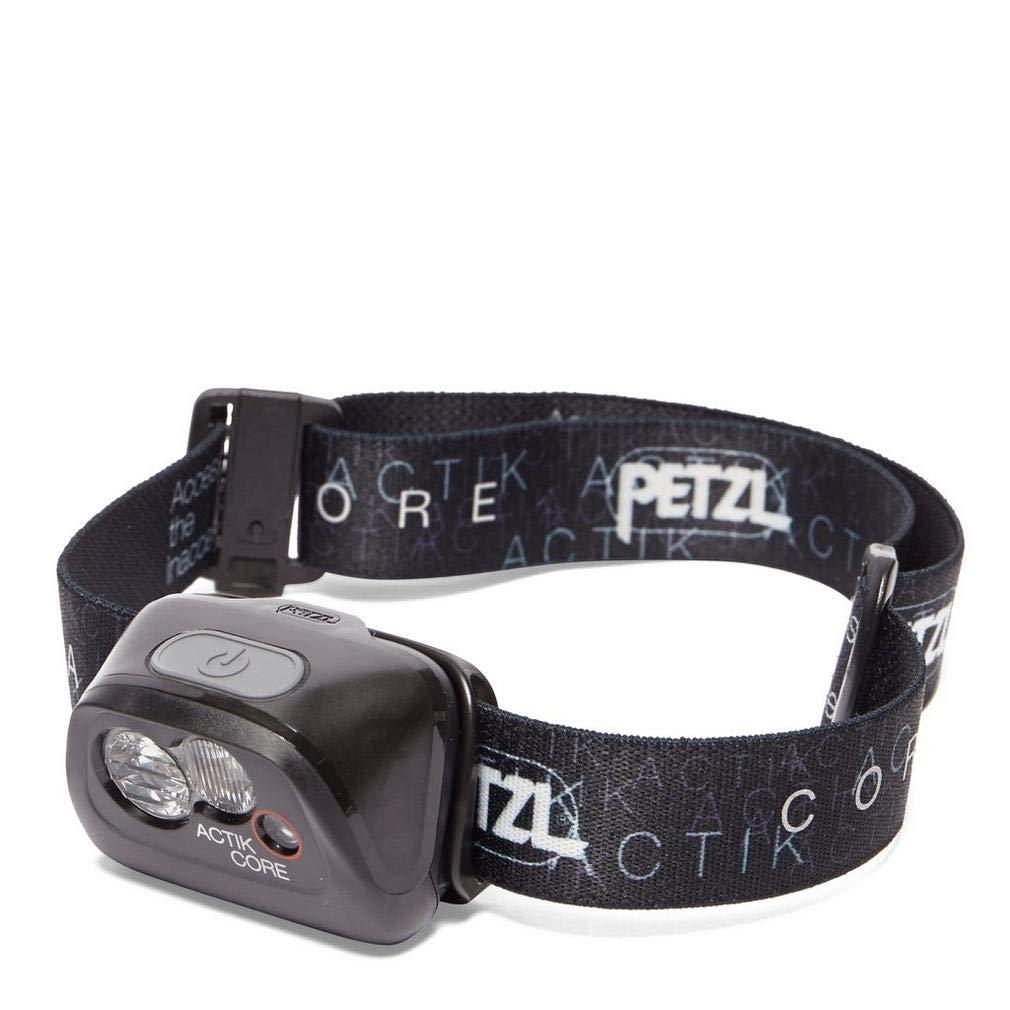
Petzl
Petzl ACTIK CORE Headlamp
625-lumen headlamp that runs on its USB-C rechargeable CORE battery or three AAA batteries. 88 g, IPX4, with a red light mode.
- 625 lumens max (450 on AAA)
- CORE rechargeable battery or 3 x AAA
- 88 g, IPX4, red lighting
Energizer
Energizer Universal LED Headlamp, 2-Pack
Two lightweight AAA headlamps with a 100-lumen white beam and a red night-vision mode. Batteries are included.
- Two headlamps in one pack
- 100 lumens, 40-meter beam distance
- IPX4 water resistant
$14.02
Amazon price as of . Details
Water and food
Pack an empty water bottle and packaged solid food. TSA allows an empty water bottle and solid food in carry-on and checked bags.
The CDC's travel packing list includes water purification tablets or a filter. TSA's list has no entry for water filters or purification tablets. The LifeStraw Personal is a 1.6 oz drink-through straw with a 0.2-micron filter rated for up to 1,000 gallons; it cannot filter water into a bottle or pot, and LifeStraw's listed protection covers bacteria, parasites, and microplastics, not viruses. Katadyn Micropur MP1 tablets use chlorine dioxide, and Katadyn says they are effective against bacteria, protozoa, cysts, and viruses. One tablet treats 1 liter of tap or clear water after a 4-hour wait, and a pack holds 30 tablets.
For food that needs no water or cooking, Datrex bars come as 18 individually wrapped 200-calorie bars, 3,600 calories in all, with a 5-year shelf life. They are a survival ration, not meals: the label dose is one 200-calorie bar every six hours.
Water and food picks
Purchases through these links support the site at no extra cost to you. As an Amazon Associate we earn from qualifying purchases. (?)
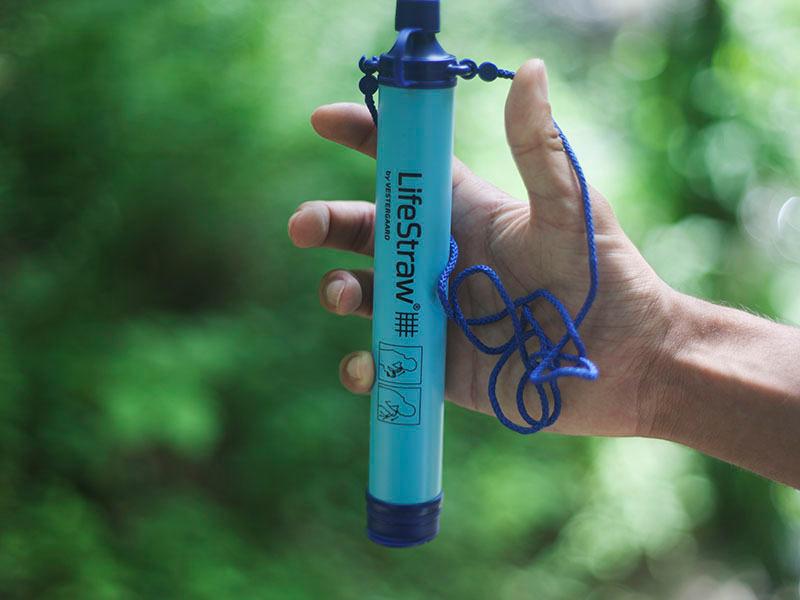
LifeStraw
LifeStraw Personal Water Filter Straw
Straw-style 0.2-micron filter rated for up to 1,000 gallons (4,000 liters). Weighs 1.6 oz and has unlimited shelf life when unused and stored properly.
- 0.2 micron membrane microfilter
- Up to 1,000 gallons / 4,000 liters
- 1.6 oz (46 g), 9 x 1.2 in
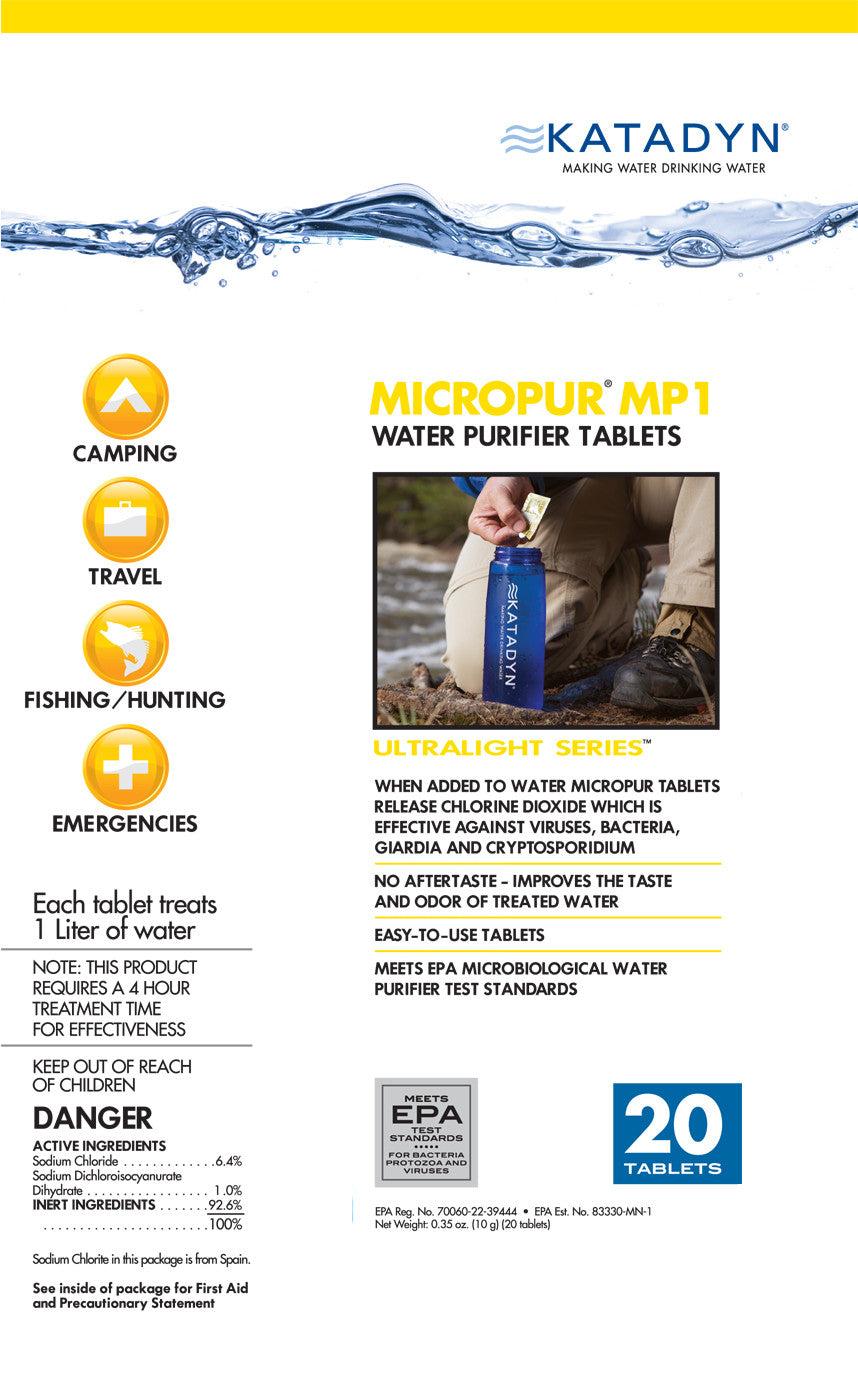
Katadyn
Katadyn Micropur MP1 Water Purifier Tablets (30 Tab)
Chlorine dioxide tablets for tap or clear water. One tablet treats 1 liter with a 4-hour exposure time, so the 30-tablet pack treats up to 30 liters.
- 30 tablets, 1 liter each
- Effective against bacteria, protozoa, cysts, and viruses (Katadyn)
- 4-hour exposure time
$17.95
Backordered· checked
Available for backorder.
Datrex
Datrex 3600 Calorie Emergency Food Bar
3,600 calories in 18 individually wrapped 200-calorie bars, vacuum bagged in polymer-foil. No water, no cooking. 5-year shelf life, U.S. Coast Guard approved.
- 3,600 calories, 18 bars
- No preparation or water needed
- 5-year shelf life
Warmth, sun, and air
Pack a warm layer, sun protection, and a mask. Ready.gov's kit list includes a warm blanket, a change of clothing, a dust mask, and a whistle. The CDC's travel list adds high-quality masks, sunscreen SPF 15 or higher with UVA and UVB protection, sunglasses and a hat, insect repellent with DEET or picaridin, and earplugs.
TSA allows blankets and hand warmers in carry-on and checked bags. The SOL Emergency Bivvy weighs 3.8 oz, opens to 84 x 36 inches, and, according to SOL, reflects 90% of body heat, with a survival whistle attached. Its sealed material does not breathe. The State Department's safety advice also suggests carrying a personal alarm or whistle.
Warmth pick
Purchases through these links support the site at no extra cost to you. As an Amazon Associate we earn from qualifying purchases. (?)
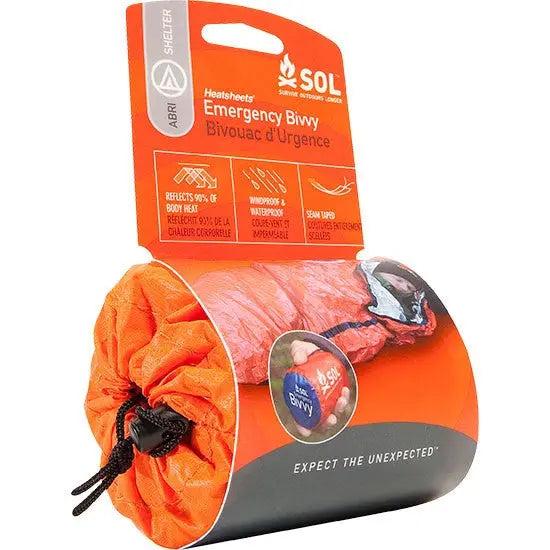
SOL
SOL Emergency Bivvy with Rescue Whistle
3.8 oz sealed reflective bivvy, 84 x 36 in, that SOL says reflects 90% of body heat. A tinder-cord drawstring and survival whistle are attached.
- Reflects 90% of body heat (SOL)
- Waterproof, windproof, sealed seams
- 3.8 oz, 84 x 36 in
What can and can't fly in a carry-on
Power banks go in the carry-on only, and carry-on liquids are limited to 3.4 ounces (100 milliliters) per container in one quart-sized bag, with medications exempt. The table lists the TSA and FAA rules for the items in this kit, plus lighters, matches, knives, multi-tools, and scissors.
| Item | TSA and FAA rule |
|---|---|
| Power banks and spare lithium batteries | Carry-on only, never checked. 100 watt hours (Wh) per lithium ion battery; with airline approval, up to two spares of 101-160 Wh. If your bag is checked at the gate or planeside, take them out and keep them in the cabin. Many airlines set stricter limits. |
| Devices with lithium batteries (phones, rechargeable headlamps) | TSA says to carry them in carry-on baggage. |
| Dry batteries (AA, AAA, C, D, non-lithium) | Carry-on and checked. |
| Flashlights | Carry-on and checked. |
| Disposable and Zippo lighters | Carry-on, limited to one lighter per passenger (FAA). Checked only without fuel, unless in a DOT-approved case (up to two). |
| Torch lighters | Not allowed in carry-on or checked bags. |
| Safety matches | One book of safety (non-strike-anywhere) matches in carry-on. No matches in checked bags. |
| Knives | Not in carry-on, except rounded-blade butter knives and plastic cutlery. Checked bags only, sheathed or wrapped. |
| Multi-tools | With a knife of any length: checked bags only. With scissors under 4 inches: carry-on allowed. With no blades: carry-on and checked. |
| Scissors | Carry-on if less than 4 inches from the pivot point. |
| Liquids, including bottled water and eye drops | Carry-on: 3.4 ounces (100 milliliters) or less per container, all in one quart-sized bag. Medications are exempt. |
| Medications | Pills: carry-on and checked. Liquid medications: larger medically necessary amounts allowed in reasonable quantities; declare them at the checkpoint. |
| Empty water bottle | Carry-on and checked. |
| Solid food | Carry-on and checked. |
| Blankets and hand warmers | Carry-on and checked. |
| First aid kits, tourniquets, water filters, water purification tablets | No entry on TSA's list. Scissors, creams, and medications inside a kit have their own rows above. For unlisted items, TSA directs travelers to AskTSA, and the final decision rests with the TSA officer. |
Travel habits: hotel exits, emergency numbers, and STEP
Before anything goes wrong, find the two closest exits at your hotel, look up the local emergency number, enroll in STEP for international trips, download offline maps, and leave your itinerary with someone at home.
Hotel exits. The U.S. Fire Administration estimates 3,900 hotel and motel fires a year, causing 15 deaths and 100 injuries (2014-2016 data), with cooking the leading cause. USFA says to read the evacuation plan, find the two closest exits, and count the doors between your room and each exit, which helps if you have to find your way in the dark. Find the fire alarms on your floor, and choose places where rooms have hard-wired smoke alarms and sprinklers. In a short-term rental, USFA says everyone should know the address and two ways out of every room, the smoke and carbon monoxide alarms should work, and the group should pick an outside meeting place.
Emergency numbers. In the European Union, 112 is free from fixed and mobile phones everywhere and reaches police, ambulance, and fire; some EU countries keep national numbers alongside it. Elsewhere, the State Department's destination page for each country lists its local emergency numbers and U.S. embassy contacts.
STEP. The State Department's Smart Traveler Enrollment Program is free. It emails you updates from the local U.S. embassy or consulate and helps the embassy reach you or your emergency contact in an emergency. Enroll at step.state.gov. For help abroad, the State Department's Overseas Citizens Services line is 888-407-4747 from the U.S. and Canada and +1 202-501-4444 from overseas.
Maps and itinerary. The State Department says to download offline map apps, tell someone at home your itinerary (hotel names, places you will visit, embassy information, and emergency contacts), and know where the local police stations and hospitals are.
Driving instead? Pack the car kit too
On a road trip, keep this kit with you and put a separate kit in the vehicle. Ready.gov tells households to prepare supplies for home, work and cars, and the car needs its own gear for a dead battery, a flat tire, or a winter storm. The car emergency kit checklist lists what to keep in the trunk year-round and by season.
Get kit checklists by email
What changed in official guidance, what it means for your kit, and what is worth doing about it.